

IN FOCUS: Ukraine & Moldova Brief
Review of June 2026
Petra Bošková, Anna Gúliková, Igor Píš, Martin Tancer
UKRAINE

Photo: Shutterstock.com
European Union Launches Accession Negotiations with Ukraine and Moldova
On June 15, 2026, a historic Intergovernmental Conference in Luxembourg marked what officials called a “big Monday for enlargement,” as the European Union formally launched accession negotiations with Ukraine and Moldova. The launch involved opening the “Fundamentals” cluster (Cluster 1). This decision follows the granting of candidate status to both countries in 2023.
Cluster 1 serves as the “backbone” of the entire accession process, meaning its chapters are the first to open and the last to close. This cluster covers the most critical components of the EU acquis, including the judiciary and fundamental rights, justice, freedom and security, public procurement, statistics, and financial control. The EU has established interim benchmarks for these chapters, and meeting these requirements is essential before negotiations can move into their concluding phase. Because Cluster 1 is so vital, the progress made here will determine the overall pace of the entire negotiation process.
The initiation of these talks was made possible by significant political changes within the EU, specifically the April 2026 elections in Hungary. The previous government under Viktor Orbán had blocked Ukraine’s path for two years, but the new administration led by Péter Magyar allowed the negotiations to proceed. However, diplomatic nuances remain. While Magyar did not oppose Moldova’s progress, he voiced reservations about opening all clusters for Ukraine “as soon as possible”. For the sake of equal treatment, EU leaders temporarily removed similar wording from the Moldova-related section of their joint conclusions.
A major theme of the current negotiations is the potential “decoupling” of the two countries. While Ukraine and Moldova have been informally paired since the start of Russia’s war, EU leaders like Ursula von der Leyen have stressed that accession is a merit-based process where every candidate is responsible for its own reform delivery. Moldova has received high praise for the speed of its reforms, with European Council President António Costa suggesting that Chișinău could “rapidly” unlock the remaining five clusters if it maintains its current momentum. Moldovan President Maia Sandu has further urged that these remaining clusters be opened “immediately and with no delays”.
For Ukraine, the situation is more complex, as decoupling is a sensitive issue that could impact national morale during the ongoing conflict. President Volodymyr Zelenskyy attended recent summits to reiterate that EU membership is a “future security guarantee” for Ukraine, stating that both countries are ready to move forward together through the remaining five clusters. Although both nations are considered “technically ready” for full cluster opening, officials express hope that the next stage of negotiations could begin as early as July 2026.
Sources:
- EUROPEAN WESTERN BALKANS, “Ukraine and Moldova launch accession talks with opening of Fundamentals cluster”, https://europeanwesternbalkans.com/2026/06/15/ukraine-and-moldova-launch-accession-talks-with-opening-of-fundamentals-cluster/
- JORGE LIBOREIRO, Euronews, “EU sets stage for decoupling Moldova’s accession bid from Ukraine’s”, https://www.euronews.com/my-europe/2026/06/22/eu-sets-stage-for-decoupling-moldovas-accession-bid-from-ukraines
- EUROPEAN COUNCIL, “Enlargement: EU and Moldova reach a milestone in accession talks with opening of the first negotiation cluster”, https://www.consilium.europa.eu/en/press/press-releases/2026/06/15/enlargement-eu-and-moldova-reach-a-milestone-in-accession-talks-with-opening-of-the-first-negotiation-cluster/
Ukrainian attacks on Russian infrastructure increase in intensity
Over the course of the past weeks, the Ukrainian army heightened the number of strikes on the Russian energy and military infrastructure, turning it into one of the defining features of the war’s fifth year. In the second half of June, Kyiv showed its clearly strong capabilities, as it launched the so-called largest single-night attack on Moscow since the full-scale invasion began in 2022. Striking the Moscow Oil Refinery in Kapotnya for a second time within a week points out that Russia is hardly capable of securing safe conditions for its citizens. Russian air defences claimed to have intercepted around 555 drones overnight, with roughly 190 shot down, as they approached the capital, yet enough got through to set the refinery ablaze, disrupting flights at Moscow airports and injuring seventeen people in the surrounding region.
The campaign has continued relentlessly since then. Ukrainian forces struck oil refineries in Yaroslavl and Slavyansk-na-Kubani in the same operation, prompting President Vladimir Putin to publicly admit, for the first time since 2022, that Russia is facing a fuel deficit. The pro-Russian authorities installed by the Kremlin in occupied Crimea have already been suspending the civilian use of gasoline sales, pinpointing the chances of the energy crisis there since the annexation. Kyiv has also shifted a part of its focus towards military-intelligence infrastructure, as on June 30, the information that Ukraine was conducting a second striking the Dubna Satellite Communications Centre north of Moscow came through. This facility, based on Zelenskyy’s statement, should be used to coordinate Russian forces occupying Ukrainian territory.
This continuous operation illustrates the civilian toll inside Russia, as well, because they do not purposefully, but hurt Russian civilians. Ukrainian officials argue that these deep strikes are meant to pressure Moscow toward negotiations rather than to punish civilians, and Kyiv has reportedly offered to halt such attacks in exchange for reciprocal restraint from Russia. But this offer was rejected by Putin. Meanwhile, Zelenskyy has mocked the Kremlin’s stalled Donbas offensive, noting that Russian commanders have repeatedly postponed their own deadlines for capturing the region, which he presents as proof that Moscow’s broader military strategy is faltering even as fighting along the front lines remains largely deadlocked.
Sources:
- AP News, “Ukrainian drones set another Russian oil refinery ablaze as Putin admits fuel shortages”, https://apnews.com/article/ukraine-russia-war-oil-refinery-drones-88370faa1a49504438388f2854d7afd3
- James Landale, BBC News, “Putin makes rare admission of fuel shortages caused by Ukrainian strikes”, https://www.bbc.com/news/articles/clyw31zvpgmo
- Costa Gak, Clare Sebastian and Anna Chernova, CNN News, “Ukraine launches major drone attack on Moscow, hitting a satellite centre and killing a baby”, https://edition.cnn.com/2026/06/30/europe/moscow-dubna-attack-ukraine-intl
- The Guardian, “Ukraine war briefing: Zelenskyy ridicules Russian military drive, saying Putin keeps postponing goal deadlines”, https://www.theguardian.com/world/2026/jun/30/ukraine-war-briefing-zelenskyy-ridicules-russian-military-drive-saying-putin-keeps-postponing-goal-deadlines
Belarusian President Makes Surprising Statements on Ukraine
In a notable shift in tone, Belarusian leader Alexander Lukashenko has explicitly ruled out any direct involvement of his country in Russia’s war against Ukraine. Speaking in an interview, Lukashenko labelled any potential spillover of the conflict onto Belarusian soil as “absolutely unacceptable” and claimed that even Russian President Vladimir Putin shares the view that Minsk entering the war in any capacity makes no strategic sense.
To justify this stance, Lukashenko pointed to Belarus’s severe military vulnerabilities, noting that his country remains completely exposed to potential Ukrainian counter-attacks. Furthermore, he warned that opening a new front line would overextend both Belarusian and Russian defensive capabilities, raising the dangerous possibility of drawing NATO forces directly into the conflict and elevating it to a full-scale regional confrontation. Beyond military and geopolitical calculus, the Belarusian leader unexpectedly cited humanitarian reasons, emphasising the deeply intertwined family ties and shared ancestry between the citizens of Belarus and Ukraine.
Adding a personal dimension to this diplomatic pivot, Lukashenko issued a rare, public apology to Ukrainian President Volodymyr Zelenskyy. He admitted that his previous harsh remarks regarding the Ukrainian president were uncalled for, especially given that Zelenskyy is currently leading a nation at war. While Lukashenko continues to advocate for a negotiated solution where both sides must compromise to end the hostilities, he reaffirmed that Ukraine has no reason to fear aggression coming from the Belarusian border, provided Minsk is not attacked first.
Sources:
- Reuters, “Belarus’ Lukashenko says both sides must compromise to end Russia-Ukraine war”
- Interfax-Ukraine, “Lukashenko apologises to Zelenskyy for harsh remarks, says Belarus has no plans for military action against Ukraine”, https://en.interfax.com.ua/news/general/1176826.html
- Kyiv Post, “Lukashenko: ‘No Military Action Should Be Expected From Belarus’”,https://www.kyivpost.com/post/78240
MOLDOVA
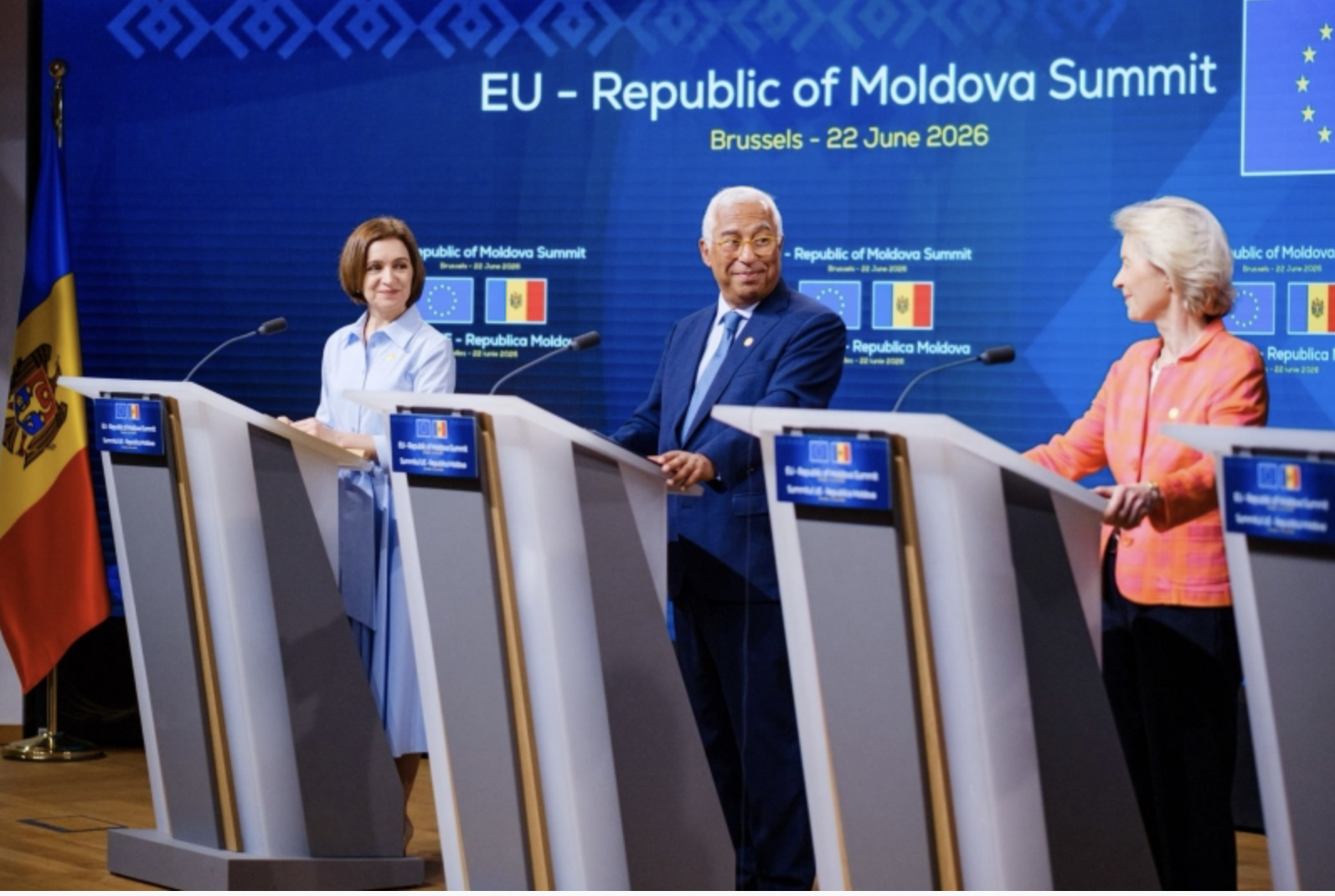
Photo: www. presedinte.md
Sandu Protests Against Romanian “Unification Bill”
Romania’s Chamber of Deputies, the lower house of parliament, has recently approved a bill proposing urgent negotiations for a formal unification with neighbouring Moldova. Under local legislative rules, the draft passed automatically after sitting without plenary debate or a vote for 45 days. However, the proposal faces massive political pushback and is far from becoming a reality, as it still requires approval from the Romanian Senate.
Despite statements that she would back a union of the two, Moldovan President Maia Sandu has openly dismissed the bill, labelling it a deliberate political trap. The legislation was introduced by Diana Șoșoacă, leader of the far-right SOS Romania party, whom Sandu directly accused of acting as a “Moscow agent.” According to Sandu, the true motive behind the proposal is not genuine reunification, but rather an attempt to sabotage and discredit the concept of a union altogether. While Sandu has previously stated she would back a merger if supported by a national referendum, she emphasised that a union cannot be forced through unilateral legislative stunts.
Predictably, the move sparked sharp criticism from Moscow. Russian Foreign Ministry spokesperson Maria Zakharova slammed the initiative, mockingly suggesting that Western nations label Bucharest’s actions as an “annexation.” The Kremlin has also escalated its rhetoric over the breakaway region of Transnistria, threatening a severe response to any actions targeting Russian citizens there.
Currently, public opinion on the matter remains divided across the borders. While a recent poll shows that roughly 72% of Romanians favour reunification, support in Moldova stands significantly lower at 41%. For Chisinau, the primary focus remains on shedding its Soviet past and securing alternative routes toward European integration amid heavy political pressure from Russia.
Sources:
- Katherina Popilnichenko, UNITED24 Media, “Romania Parliament Lower House Backs Unification Bill With Moldova”,https://united24media.com/world/romania-parliament-lower-house-backs-unification-bill-with-moldova-20144
- Iulian Ernst, Romania Insider, “Unionist bill in Romania prompts negative reactions from Moldova and Russia”,https://www.romania-insider.com/reactions-moscow-moldova-union-project-sos-jun-2026
- net, Universul.net, “Moldovan president supports unification with Romania, but calls new bill a trap”,https://universul.net/moldovan-president-supports-unification-with-romania-but-calls-new-bill-a-trap/
Moldova’s economic prospects with Ukrainian refugees and the simplification of citizenship access
Since Russia’s full-scale invasion in 2022, Moldova has hosted more displaced Ukrainians per capita than any other country, and evidence increasingly suggests that this population has become an economic asset rather than a burden. Ukrainian refugees have paid approximately $90 million (around 1.6 billion MDL) in taxes and social contributions since 2022 and have opened more than 200 businesses in the country. UNHCR figures show that as of early 2026, nearly 140.000 Ukrainian refugees still reside in Moldova, and more than 47.000 people have renewed their temporary protection status since the start of the year alone, with a further 4.700 submitting new applications.
Business circles in Moldova have noted that Ukrainians are helping compensate for domestic labour shortages and are contributing directly to local economic development, even though integration remains complicated through language barriers, difficulties in recognising professional qualifications, and adaptation to local labour-market requirements. Parallel to these economic gains, Kyiv has moved to make it easier for Ukrainians living in Moldova to formalise their status. The Ukrainian Prime Minister announced that the government has added Moldova to the list of countries eligible for a simplified procedure for obtaining Ukrainian citizenship, following a meeting with her Moldovan counterpart. Kyiv’s representative described the move as a logical step given the two countries’ shared border, shared European path, and the large Ukrainian community already living in Moldova. Kyiv is now working to make the process more convenient still, including allowing the mandatory exams on the Ukrainian language, constitution, and history, which are currently only available inside Ukraine, to be taken remotely, and streamlining the final stage of document processing through diplomatic missions abroad.
Taken together, the two developments point in the same direction: rather than treating Ukrainian displacement purely as a humanitarian cost, both Chisinau and Kyiv are increasingly building formal mechanisms, from entrepreneurship incentives to simplified citizenship, to convert the refugee presence into a source of long-term economic and demographic integration between the two countries.
Sources:
- Olena Mkhina, Euromaidan Press, “Not burden: Ukrainian refugees in Moldova opened 200 businesses and paid $90 million in taxes since 2022”, https://euromaidanpress.com/2026/06/30/not-burden-ukrainian-refugees-in-moldova-opened-200-businesses-and-paid-90-million-in-taxes-since-2022/
- UNHCR Moldova, “Shared futures: supporting refugees through access to work”, https://www.unhcr.org/md/en/news/press-releases/shared-futures-supporting-refugees-through-access-work
- UKRINFORM, “Procedure for obtaining Ukrainian citizenship to be simplified for Ukrainians in Moldova”, https://www.ukrinform.net/rubric-society/4137959-procedure-for-obtaining-ukrainian-citizenship-to-be-simplified-for-ukrainians-in-moldova.html
Contact us