

Strategic Analysis Caucasus Brief
Review of June 2025
Tomáš Baranec
Armenia

Photo:Shutterstock.com
Political Crisis Deepens Between Armenian Government and Apostolic Church
On May 30, Prime Minister Nikol Pashinyan suggested that the head of the Armenian Church, Karekin II, has a child, starting a new round of ongoing conflict with the Church. “If it turns out that Karekin II has indeed broken his vow of celibacy and has a child, he cannot remain the Catholicos of All Armenians,” Pashinyan wrote. He elaborated that from the moment the “fact” of him having a child existed, Karekin II “could no longer have been a celibate priest”.
Pashinyan claimed that he raised the issue, suggesting that in it he saw “a threat to spiritual security” as a follower of the Armenian Apostolic Church, while as prime minister, he saw “a threat to national security”. Just days before directing his accusations at the head of the Church, Pashinyan made another controversial statement, declaring that the Armenian state “must have a decisive voice in the election of the Catholicos of All Armenians” and that candidates must undergo an “integrity check”. Pashinyan has proposed creating and personally appointing a council to elect a new Catholicos of the Armenian Apostolic Church. In a lengthy social media post on June 7, he laid out the criteria for candidates applying to join the council. He urged those interested to send their application directly to his email, saying he would ”take responsibility” for the selection of the council’s first 10 members.
Pashinyan’s criteria for members of the council included five requirements: a belief in the “living Lord, Jesus Christ”, having fully read the Bible, having observed Lent at least once in the past five years, and praying daily.The final requirement says that candidates are expected to “believe that the agenda of the renewal of the Mother See stems from the interests of the Armenian Apostolic Holy Church, our people, and our state, and is in accordance with the sacred tradition of our ancestors”.
Pashinyan’s posts were widely criticised online, by rights advocates and also the opposition, both for his harsh language, for his intervention in church affairs in a secular state and “war” against the Church. Meanwhile, Father Zareh Ashuryan, the spokesperson for the Patriarch of the Armenian Apostolic Church, Karekin II, implied that the head of government was circumcised, therefore not a Christian. “I believe that our Apostolic Holy Church must immediately cleanse itself of those false ‘believers’ who are traitors to the nation, have dishonoured the memory of their ancestors, broken the vow of baptism and replaced the seal of the Holy Cross with the sign of circumcision,” Father Ashuryan said. Pashinyan responded in a post on Facebook, saying he was ready to accept the challenge and prove he had nothing to do with being circumcised, a religious practice not common among Christians in the country.
The antipathy between the government and the Church’s leadership became more open in the aftermath of Armenia’s defeat in the Second Nagorno-Karabakh War in 2020, when the head of the Church joined calls for Pashinyan’s resignation. In April 2023, Karekin II again reaffirmed his call for Pashinyan to resign, prompting Pashinyan to state that “if the church wants to carry out political activities, Armenia is a democratic country”.
Recently, Karekin II demanded the right of return for the Armenians who fled Nagorno-Karabakh, a region of Azerbaijan that it recaptured in 2023. The prime minister’s allies are unhappy with such interventions, as they contradict the government’s position in the ongoing peace talks. Pashinyan pushes for a swift peace treaty that would see both countries drop mutual claims. But Azerbaijani media seized on nationalist opposition demands as proof that Armenia is not ready for peace.
Sources:
-
BARSEGHYAN Arshalys, OC Media, “Pashinyan suggests that the head of the Armenian church has a child”, https://oc-media.org/pashinyan-suggests-that-the-head-of-the-armenian-church-has-a-child/
-
Atanesian Grigor, BBC, “Armenia’s PM accuses head of Church of fathering child in febrile political row”, https://www.bbc.com/news/articles/cpd1qnq87jxo
-
BARSEGHYAN Arshalys, OC Media, “Pashinyan proposes personally appointing council to replace head of Church”, https://oc-media.org/pashinyan-proposes-personally-appointing-council-to-replace-head-of-church/
Pashinyan and his wife under fire for using the state budget for an education campaign
The Armenian authorities have revealed that the “Learning is Trendy” education campaign, founded by Prime Minister Nikol Pashinyan’s wife, Anna Hakobyan, has been funded by the state — an initiative critics say is part of a pre-election strategy. Learning is Trendy is a series of talks modelled after TED Talks, created by Hakobyan as part of the movement bearing the same name, launched in November 2024. The talks have been held since March by Hakobyan’s My Step Foundation, with Pashinyan frequently featuring as a guest speaker in events across the country.
During a June 6 session of the National Assembly, Chief of the Prime Minister’s Staff Arayik Harutyunyan revealed that the campaign was being funded by the Prime Minister’s Office. Panorama.am submitted an inquiry to the government’s Information and Public Relations Department, seeking clarification on several key issues: Since when has the campaign been funded from the state budget? What is its legal basis? How much has been spent on the campaign up to June 9, 2025? Panorama also requested a detailed breakdown of the expenses, including costs related to venue rentals, transportation, accommodation and the production of campaign materials.
In its official response, the government stated that the campaign’s event management services are part of a procurement plan that includes classified information. Therefore, it claimed that the requested data is not subject to public disclosure. The government further clarified that only the events attended by Pashinyan are directly funded by the Prime Minister’s Office. The fact that the events, which had been promoted as an initiative of the Hakboyan-led foundation, had been funded by the budget raised concerns among government watchdogs, with some describing it as a pre-election strategy.
The audiences of the talks mostly consisted of teachers. Audience members had to register to attend the talks, and their phones and other video recording devices were reportedly collected during the event, according to RFE/RL, as cited by OC Media. Previously, Pashinyan revealed that the Family Podcast, hosted by him and Hakobyan and launched in late 2024, was produced and filmed by a crew working for the government. “Even though it’s a family podcast, it’s also part of the Prime Minister’s activities. The same operators who cover my visits, government sessions [etc.], also film the podcast, edit it in the same way, and so on,” Pashinyan said during a press briefing in January 2025.
Sources:
- BARSEGHYAN Arshaluys, OC Media, “Pashinyan and his wife under fire for using state budget for education campaign”, https://oc-media.org/pashinyan-and-his-wife-under-fire-for-using-state-budget-for-education-campaign/
- Panorama.am, “Government refuses to disclose budget for Learning is Trendy campaign”, https://www.panorama.am/en/news/2025/06/16/government-campaign/3133899
Russian-Armenian Billionaire Samvel Karapetyan charged with “usurping power”
Russian-Armenian billionaire and Tashir Group founder Samvel Karapetyan was formally charged with inciting the overthrow of the Armenian government on June 17, his lawyer told reporters. This comes amid an intensifying dispute between the businessman and Prime Minister Nikol Pashinyan’s administration, writes BNE Intellinews.
Karapetyan, who is well known for his philanthropic endeavours and significant investments in Armenia, was arrested after his Yerevan residence was searched on June 17. He is also well-known due to his ties with Russia, and through his companies, Russia controls the electricity market in Armenia. According to his lawyer, Armen Feroyan, the arrest was based on remarks the tycoon made in defence of the Armenian Apostolic Church in an interview, in which he criticised the government for attacking religious institutions.
The Armenian Investigative Committee confirmed the charges under Part 2 of Article 422 of the Criminal Code, which addresses public calls for the violent seizure of power. Karapetyan was identified as one of the people on wiretaps suggesting they were preparing an armed overthrow of the current Government of Armenia. Except for Karapetyan, 13 other persons, including at least two high-ranking Armenian Apostolic Church officials, were arrested for the preparation of a coup.
Karapetyan’s legal experts, including lawyers, Ruben Hakobyan, argue that the charges are politically motivated. Hakobyan claimed that the investigation had violated multiple legal procedures, including the prolonged detention of over 50 individuals taken from Karapetyan’s residence during the raid.
“This is not a legal case, but a political operation,” he said. “The coercive measures used, the breach of constitutional protections, and the attempt to imprison Karapetyan are all signs of an illegal and targeted campaign.” Karapetyan denies any wrongdoing. In his controversial interview, he stated: “If the politicians fail, we will act in our own way”, in reference to defending the Church and national values. His supporters have interpreted these remarks as symbolic rather than seditious.
On June 18, a Yerevan court ordered Karapetyan’s two-month pre-trial detention. That same day, Pashinyan announced the nationalisation of Electric Networks of Armenia (ENA), owned through Cyprus-based Liormand Holdings Limited—a company tied to the Karapetyans. Following the announcement, the government swiftly moved to assert control over ENA. New draft laws enabling state seizure of ENA were introduced in Parliament, and an emergency session was scheduled for July 1, 2025, at Pashinyan’s request.
An emergency session of Parliament is set for July 1, where the government plans to pass the nationalisation law. The legislation would allow the appointment of a temporary manager to replace ENA’s director and strip its shareholders and board of their powers—an act Meloyan says amounts to expropriation without constitutional safeguards. “If adopted, it would mean a single state official appoints a manager who assumes all powers of a private company’s executive, sidelining its board and shareholders,” Meloyan wrote. “This is a direct violation of constitutional protections against unlawful seizure of property.”
Prime Minister Pashinyan insists the plan is ready. He earlier claimed ENA’s soon-to-be former owners used the Church as cover and accused the company of nearly triggering an energy crisis.
Constitutional expert Gohar Meloyan wrote on Facebook that the draft law enabling ENA’s nationalisation contradicts Article 60 of Armenia’s Constitution. On the other hand, the Government of Armenia views the nationalisation of the electric distribution company back into Armenian hands as a means of controlling the electricity market and as a tool for reducing Russia’s influence in Armenia’s energy market.
Sources:
-
AVETISYAN Ani, BNE Intellinews, “Armenian authorities detain Russian-Armenian tycoon Samvel Karapetyan”, https://www.intellinews.com/armenian-authorities-detain-russian-armenian-tycoon-samvel-karapetyan-386791/
-
PanArmenian.net, “Samvel Karapetyan notifies Armenia of investment dispute”, https://www.panarmenian.net/eng/news/323993/
Armenian ex-prime minister arrested on charges of money laundering and abuse of power
Yerevan law enforcement arrested former Armenian Prime Minister Hovik Abrahamyan on charges of money laundering, abuse of official authority, and illegal business activity. Abramyan served as prime minister from April 2014 to September 2016. From May 2012 to April 2014, he was the president of Armenia’s Parliament.
This is not the first time Abrahamyan, who has extensive business holdings in Armenia, has been charged with such crimes. In 2023, Abrahamyan was charged with illegally using his official powers to take control of a company engaged in sand mining in Armenia and receiving profits amounting to 230.4 million AMD (593.400 USD).
In 2019, Armenia’s Investigative Committee launched a criminal case charging several former government officials, including Abrahamyan, with exploiting the power of their office to privatise more than fifty hectares of land, some of it state-owned forest, in Armenia’s Tzaghkadzor region.
Sources:
-
BALASANYAN Grisha, Hetq.am, “Former Armenian PM Hovik Abrahamyan Arrested for Money Laundering, Illegal Business Activity”, https://hetq.am/en/article/174940
Azerbaijan

Photo:Shutterstock.com
Relations between Moscow and Baku plunged to new lows
A diplomatic crisis has flared up between Russia and Azerbaijan following the deaths of two Azeri men during a raid in the Russian city of Yekaterinburg. The incident has prompted swift retaliation from Baku, including a police raid on the local bureau of Sputnik, a Russian state news agency, wrote Mediazona.
On June 27, Russian security forces detained dozens of people of Azerbaijani descent in the major Urals city of Yekaterinburg. The operation was officially linked to a long-running investigation into murders and attempted murders allegedly committed by an “ethnic criminal group” between 2001 and 2011.
During the raids, Guseyn and Ziyaddin Safarov, two brothers who owned a local café, died. Russia’s Investigative Committee later stated that the preliminary cause of one death was heart failure, while the cause of the second is still being established. However, relatives and Azerbaijani officials have alleged the men were tortured.
In its turn, Azerbaijan’s Foreign Ministry summoned Russia’s charge d’affaires, Pyotr Volokovykh, to protest what it called the “brutal killing”. One day later, on June 29, Azerbaijan cancelled all cultural events planned by Russian state and private institutions. Azerbaijan’s Culture Ministry wrote on X that concerts, exhibitions, festivals and performances were cancelled on account of “the demonstrative targeted and extrajudicial killings and acts of violence committed by Russian law enforcement agencies against Azerbaijanis on ethnic grounds in Yekaterinburg.” “Recently, such cases have become systematic,” it pointed out. The Azerbaijani Foreign Ministry demanded “an immediate investigation into the case and bringing those responsible for this unacceptable act of violence to justice as soon as possible”.
On June 30, police in the capital, Baku, raided the office of Sputnik, a Russian state news agency. Officials justified the operation by claiming the agency had continued to work despite its local branch being formally shut down in February. Azerbaijani media later reported that two employees, Executive Director Igor Kartavykh and Editor-in-Chief Yevgeny Belousov, had been detained, alleging they were agents of the FSB, Russia’s main security service, working under journalistic cover.
Following the Sputnik raid, Russia’s foreign ministry, in turn, summoned the Azerbaijani ambassador to protest the “unfriendly actions” and the “illegal detention of Russian journalists”. Meanwhile, other detainees subsequently appeared in court with visible injuries. One man, Ayaz Safarov, had severe bruising on his face; another, Mazahir Safarov, said he suffered broken ribs. At least three other men were reportedly hospitalised following the detentions, with one, Kamal Safarov, said to be in intensive care. Oxu.Az later published photos of two heavily bruised Azeri men who were released after questioning.
The Yekaterinburg court has since placed three men, Mazahir, Ayaz and Akif Safarov, in pre-trial detention. According to the local news outlet E1, which broke many details of the story, as many as 15 people are being investigated in connection with the case, including nine brothers from the Safarov family.
The bodies of Ziyaddin and Huseyn Safarov were handed over to their relatives back in Azerbaijan on June 30. Azerbaijan’s Consulate General in Yekaterinburg is overseeing all necessary documentation and coordinating the handover, News.Az reports, citing local media. The bodies will be transported to Azerbaijan via a direct Yekaterinburg-Baku flight.
Earlier in June, the Moskovsky District Court of Saint Petersburg handed down verdicts to the alleged members of a criminal group dubbed the “Azerbaijani mafia”. In total, 16 members of the group were sentenced in a trial held behind closed doors due to the presence of minors among the accused. Most were charged with inciting national hatred and hooliganism involving violence. According to the Prosecutor’s Office, starting in 2023, the group randomly attacked passersby in Saint Petersburg, targeting mainly ethnic Russians and Uzbeks. Three members were natives of Dagestan.
In an apparent revenge, Azerbaijan police rounded up a group of at least 13 ethnic Russians living in Azerbaijan, beat them badly and showed them in court and accused them of drug trafficking and cyber crimes. In reality, those were likely digital nomads from Russia who had fled the country to avoid mobilisation as early as 2022/2023 and had resided in Azerbaijan. Azeri institutions have now arrested them in an apparent “eye-for-eye“ action mimicking videos coming out from Russia on how Azeris are being handled there by the Russian security services. The Russia–Azerbaijan tension in relations is therefore further escalating.
Sources:
-
CHIKHAROVA Elizaveta, OC Media, “Members of ‘Azerbaijani mafia’ sentenced in Russia”, https://oc-media.org/members-of-azerbaijani-mafia-sentenced-in-russia/
-
Mediazona, “Brotherly to bruising. Russia and Azerbaijan swap raids in spiralling diplomatic feud after two men die in Yekaterinburg”, https://en.zona.media/article/2025/06/30/azerus
-
Euronews.com, “Azerbaijan cancels Russian cultural events over deaths of two citizens”, https://www.euronews.com/my-europe/2025/06/30/azerbaijan-cancels-russian-cultural-events-over-deaths-of-two-citizens
-
The Moscow Times, “Azerbaijan-Russia Rift Deepens After Deaths of Azeri Men in Police Arrests”,https://www.themoscowtimes.com/2025/06/30/azerbaijan-russia-rift-deepens-after-deaths-of-azeri-men-in-police-arrests-a89610
-
News.az, “Bodies of Azerbaijanis killed in Russia’s Yekaterinburg handed over to relatives”, https://news.az/news/bodies-of-azerbaijanis-killed-in-russias-yekaterinburg-handed-over-to-relatives
Azerbaijan hands down lengthy sentences to Bahruz Samadov and the Abzas Media team
Bahruz Samadov, a PhD student at Charles University in the Czech Republic, has been sentenced to 15 years in prison by the Baku Grave Crimes Court. He was convicted under Article 274 of the Azerbaijani Criminal Code (treason), a charge he and his supporters deny. Samadov was arrested on August 21, 2024, by the State Security Service. He is known for his academic work on the Azerbaijan-Armenia conflict and for his criticism of the Azerbaijani government. According to Samadov, the charges are fabricated and politically motivated. He maintains there is no evidence linking him to Armenian intelligence and says he is being punished for his peaceful academic and anti-war views.
On June 19, Samadov began a hunger strike in protest of his imprisonment. Following the state prosecutor’s demand for a 16-year sentence on June 20, he reportedly attempted suicide on June 21, but was saved by a fellow inmate, according to his grandmother. He ended his hunger strike shortly afterwards due to worsening health, including severe eczema and facial bleeding. Feminist activist Gulnara Mehdiyeva reported that pressure from his family, particularly his elderly grandmother, also played a role in his decision.
At the same time, an Azerbaijani court has sentenced seven journalists from Abzas Media to prison terms ranging from seven to nine years after a financial crimes trial widely condemned by press freedom and human rights groups as a sham. The journalists deny all accusations, calling them retaliation for their professional work. “The case against Abzas Media is an example of how Azerbaijan’s judicial system is being weaponised to muzzle independent journalism and calls for a strong international response,” said Marie Struthers, Amnesty International’s Eastern Europe and Central Asia Director, after the verdict. “The political repression in Azerbaijan today is staggering, yet we lack a united, principled stand against it from the international community in defence of human rights. In stark contrast, major actors like the European Union persist in actively courting President Ilham Aliyev in search of lucrative gas deals,” she added.
Abzas Media’s director, Ulvi Hasanli, and editor-in-chief, Sevinc Vaqifgizi, were each sentenced to nine years. Deputy Director Mahammad Kekalov received a seven-year and six-month sentence. Reporters Elnara Gasimova and Nargiz Absalamova were sentenced to eight years each, while freelance journalist Hafiz Babali also received nine years. Also sentenced was economist and RFE/RL journalist Farid Mehralizade, who was arrested in May 2024 as part of the same case. Abzas Media noted that while Mehralizade had once been quoted as an expert, he had no connection to the outlet. He, too, received a nine-year sentence.
On June 26, OC Media reported that an imprisoned member of the Desk Confederation of Trade Unions (DCTU), Elvin Mustafayev, was reportedly beaten by 15 people in prison. Trade union activist Sara Rahimova stated on social media that unknown individuals tried to beat Mustafayev to death in prison, but he survived. “Elvin survived the brutal beating purely by chance, with serious injuries”, the statement read. Rahimova said that Mustafayev was kept from seeing his family for over a month to hide his injuries. “His family, his friends, and even his lawyer had no access to him. His court hearings were postponed”, stated Rahimova.
Mustafayev is one of the four members of the DCTU who were sentenced to three years in prison on drug charges. He has denied these charges. Mustafayev faced torture after he announced that he would join the hunger strike of Tofig Yagublu, a prominent politician who was sentenced to nine years in prison.
Sources:
-
Meydan.TV, “Friday Wrap-up: Bahruz Samadov sentenced to 15 years, youth activist Agshin Abdullayev detained, AbzasMedia journalists protest prison transfer, and Azer Gasimli’s trial begins”, https://www.meydan.tv/en/article/friday-wrap-up-bahruz-samadov-sentenced-to-15-years-youth-activist-agshin-abdullayev-detained-abzasmedia-journalists-protest-prison-transfer-and-azer-gasimlis-trial-begins/
-
OCCRP, “Azerbaijan Hands Long Prison Sentences to 7 Journalists, Critics say Trial was a Sham”, https://www.occrp.org/en/news/azerbaijan-hands-long-prison-sentences-to-7-journalist-critics-say-trial-was-a-sham
-
FARHADOVA Aytan, OC Media, “Jailed Azerbaijani activist ‘almost beaten to death’ in prison”, https://oc-media.org/jailed-azerbaijani-activist-almost-beaten-to-death-in-prison/
Azerbaijan signs record 4.6 billion USD deal for 40 JF-17 Thunder fighter jets from Pakistan
Azerbaijan has expanded its purchase of Pakistani JF-17 Thunder fighter jets from 16 to 40 aircraft, marking the largest export contract in the history of Pakistan’s defence industry. The deal is part of a wider 4.6 billion USD defence agreement, coupled with a 2 billion USD investment package, officially confirmed by the Pakistani government through its social media channels.
This agreement establishes Azerbaijan as the largest export customer for the JF-17 Thunder series, surpassing previous buyers such as Nigeria and Myanmar. Developed jointly by Pakistan Aeronautical Complex and China’s Chengdu Aircraft Corporation, the JF-17 is seen as a cost-effective solution for countries seeking modern air combat capabilities.
Azerbaijan will receive the Block III variant, the most advanced version of the JF-17, which includes an Active Electronically Scanned Array (AESA) radar and upgraded avionics. The aircraft is also compatible with long-range PL-15 and PL-10 air-to-air missiles, offering enhanced operational performance.
Sources:
- Defence Industry EU, “Azerbaijan signs record $4.6 billion deal for 40 JF-17 Thunder fighter jets from Pakistan”, https://defence-industry.eu/azerbaijan-signs-record-4-6-billion-deal-for-40-jf-17-thunder-fighter-jets-from-pakistan/
Georgia
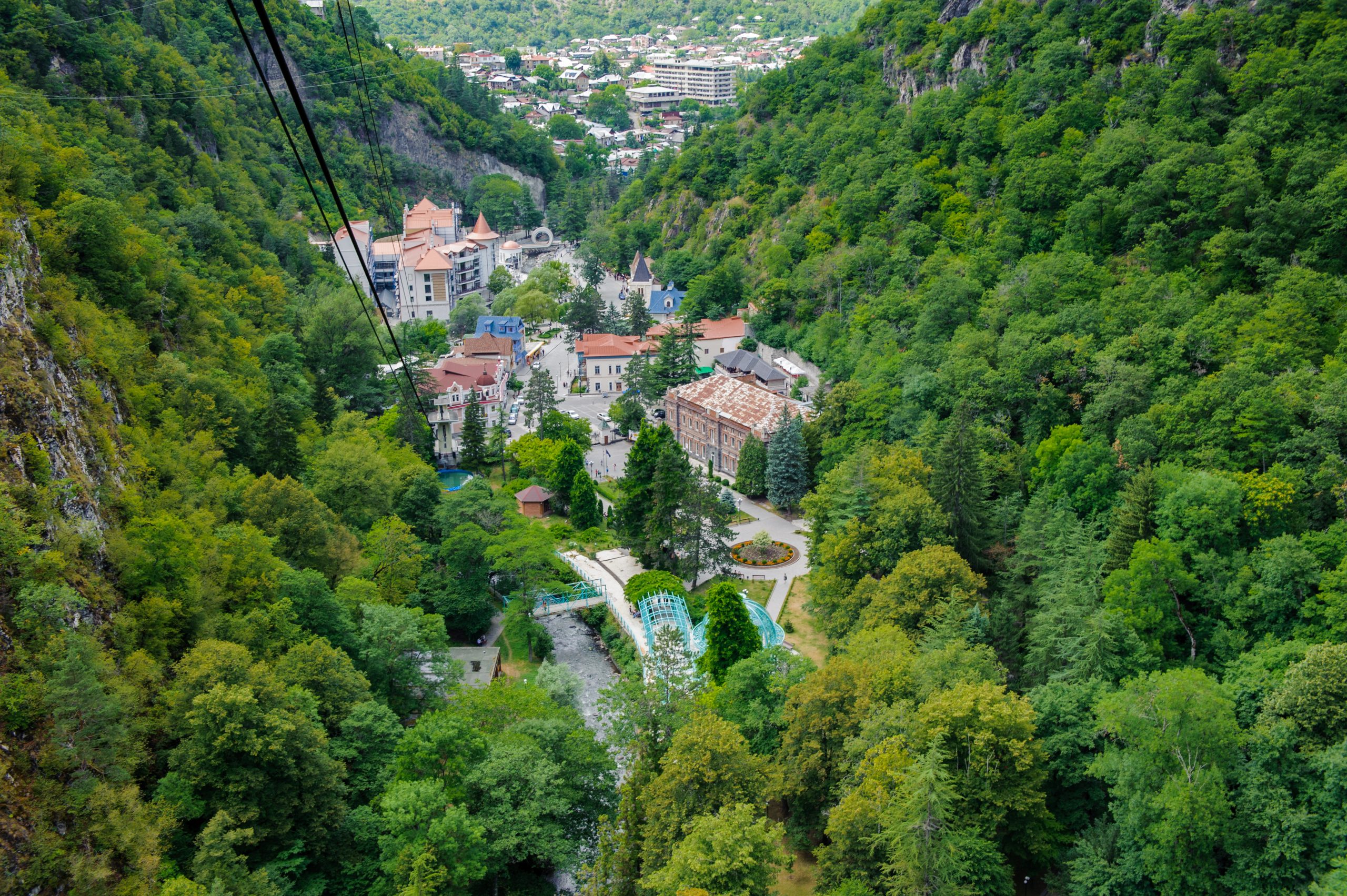
Borjomi, spa town in Georgia. Photo: Anton Ivanov/ Shutterstock.com
Georgia sees an increasing number of punishments for criticising representatives of the ruling party
By June 12, up to 20 prominent activists, journalists, and opposition politicians had received court summons in Georgia for “insulting” members of the ruling Georgian Dream party on social media, reported OC Media. Reports of the summons first emerged in early June, with cases concerning Georgian Dream MPs Nino Tsilosani, Mariam Lashkhi, Tea Tsulukiani, Davit Matikashvili, Irakli Zarkua, and Mamuka Mdinaradze.
Among those summoned are high-profile activists and opposition politicians, including opposition leaders Aleko Elisashvili and Elene Khoshtaria. In her reaction, Khoshtaria, the leader of the Droa party, announcedthat evening she had been summoned to court for insulting MPs Tsilosani and Lashkhi. In a Facebook post later that evening, Khoshtaria cursed at members of Georgian Dream, including Lashkhi and Parliamentary Speaker Shalva Papuashvili, and defended the use of insulting language against officials.
By June 18, the Tbilisi City Court had issued around a dozen fines, ranging from 3,000 to 4,000 GEL (approximately 1,100 to 1,500 USD). Journalist Dea Mamiseishvili was among the first to be fined, with the court ordering her to pay 3,000 GEL for calling Georgian Dream MP Mamuka Mdinaradze a “bastard” and “scum” in a social media post. TV Pirveli anchor Ekaterine Mishveladze was fined 4,000 GEL for sharing a photo of an inscription that read, “Mariam Lashkhi — Russian Slave,” spray-painted on the entrance wall of the MP’s apartment block. She captioned the Facebook post with the comment, “The slave was told, even in her own home, who she is.”
Human Rights Defender Levan Ioseliani criticised those insulting politicians, saying “hate speech, bullying, incitement to violence, or profanity against public figures” were unacceptable. “Expression of opinion, including for political purposes, cannot be aimed at harming or degrading a specific person. This is the standard, as the Strasbourg Court interprets Article 10 of the Convention”, he said, according to Netgazeti.
Tsilosani defended the summons, saying they served as “an example for people used to insulting others, slandering, accusing, and a hate campaign for which they are funded”. She additionally claimed that “no one will be detained” as a result of the complaints. “Don’t deceive your audience; no one will be detained. There is an administrative fine for this, and the fine will teach everyone to be polite and cultured”, she said, according to Tabula.
However, as OC Media reminded, Georgian Dream is likely summoning its critics using one of the many laws it passed amidst the ongoing anti-government protests, which introduced insulting officeholders as an administrative offence. The article provides for a fine of up to 4,000 GEL (1,500 USD) or administrative arrest for up to 45 days. At least three persons were detained for insulting GD members. Tatia Apriamashvili and Lika Lortkipanidze served 12-day administrative sentences following a protest targeting a ruling party MP, Mariam Lashkhi. The incident took place on May 17, when a group of activists approached Lashkhi while she was at a café with her children. The activists shouted slogans including “Freedom to the regime’s prisoners,” “Down with the Russian regime,” and “Down with the rotten empire of Russia.”
Lashkhi subsequently filed a formal complaint, citing harassment during a private moment with her family. At the same time, activist Albi Kordzaia has been declared an administrative violator by the court and has been subjected to 10 days of detention for insulting Tea Tsulukiani, the chairwoman of the temporary investigative commission of the Parliament. According to representatives of the Ministry of Internal Affairs, on April 2, Albi Kordzaia called Tea Tsulukiani a “slave of Russia” and a “traitor” through a loudspeaker.
Multiple Georgian Dream critics, including opposition politicians, journalists, and activists, have been fined for Facebook posts that a court deemed “insults” to ruling party MPs.
Sources:
- Front News Georgia, ”Georgian activists released after serving 12-day detention over protest incident targeting ruling party MP”, https://frontnews.ge/en/news/12-dghiani-patimrobidan-tatia-aphriamashvilits-gatavisuphlda
- Civil.ge, “Court Fines GD Critics over Facebook Posts ‘Insulting’ Ruling Party MPs”, https://civil.ge/archives/687424
- BARDOUKA Yousef, OC Media, Up to 20 summoned to court in Georgia for insulting Georgian Dream MPs online
- Interpressnews, “10 days of detention ordered for Albi Kordzaia for insulting Tea Tsulukiani”, https://www.interpressnews.ge/en/article/140221-10-days-of-detention-ordered-for-albi-kordzaia-for-insulting-tea-tsulukiani/
Several protesters sentenced to long prison terms in Georgia
At least four protesters were sentenced to long-term sentences in June for alleged attacks on security forces. On June 2, Tbilisi City Court sentenced activists Daniel Mumladze and Guram Khutashvili to three years in prison for damaging surveillance cameras during protests on Tbilisi’s Rustaveli Avenue in December 2024. Mumladze, 23, and Khutashvili, 26, were detained in December on separate occasions but under the same charges. Both admitted to the offence and sought a plea bargain that would grant their release on parole. However, the prosecutors rejected the deal.
Judge Lili Mskhiladze rejected the defence’s motion to reduce the jail term by one-third. According to Publika, she cited frequent “violent activities against state interests” as the reason for denying a more lenient ruling. On June 12, Judge Nino Galustashvili found Mate Davidze, 21, guilty of assaulting a police officer and sentenced him to 4 years and 6 months in prison. Mate Davidze did not attend the verdict, leaving the courtroom after the final speech, saying he “couldn’t listen to this.” The judge’s decision was met with noise and shouting in the courtroom.
Three police officers – Bidzina Zhamerashvili, Levan Kodalashvili and Giorgi Estatishvili – have the status of victims in the Mate Devidze case. Specifically, according to the prosecutor’s office, the defendant hit them with a flagpole. On June 4, Tbilisi City Court sentenced Denis Kulanin, a Russian activist based in Georgia, to two years in jail for “damaging a police car” on March 28 during a protest outside the Parliament. Kulanin was convicted of property damage, which is punishable by a fine or imprisonment for 1–5 years. “I did this in a state of affect, I was scared, they started arresting people, I got scared, the first thing I did, I hit the glass, I didn’t expect it to break, when I realised that it broke, I left the area and I apologise for it too”, he said during a hearing on April 1. Kulanin’s case did not receive significant public attention, and his sentencing came as a surprise to many, as the trial concluded in an unusually short period compared to those of others arrested during protests since spring 2024. Egor Kuroptev, a Russian human rights defender and political activist based in Georgia, told OC Media that this may have been a deliberate decision by Kulanin’s lawyers, wrote OC Media.
On June 20, the Ministry of Internal Affairs arrested activist and teacher Nino Datashvili on charges of assaulting a bailiff at the Tbilisi City Court. “Our investigation has ascertained that on June 9, 2025, Nino Datashvili, born in 1982, disobeyed bailiffs of Tbilisi City Court and assaulted one of them. We arrested Datashvili based on a judge’s warrant. This crime carries a penalty of 4 to 7 years of imprisonment,” stated the Ministry of Internal Affairs. The incident that led to Nino Datashvili’s arrest occurred on June 9 at the Tbilisi City Court. Nino Datashvili was standing in front of the courtroom where a session for eight prisoners of conscience was being held. Bailiffs demanded she leave the area and physically attempted to remove her.
Nino Datashvili told them not to touch her, at which point one of them grabbed her in the chest area with both hands and tried to forcibly remove her using physical force. Nino Datashvili then slapped this specific bailiff in the face, after which the bailiff grabbed her head in his arms, choked her, and continued to try to expel her. The woman fell in the corridor of the courthouse. She was helped up. Nino Datashvili verbally insulted them, after which the bailiffs, again using force, expelled her outside. Similar charges under this article of the Criminal Code have earlier been filed against Mzia Amaglobeli, the director of Batumelebi and Netgazeti.
Sources:
- Civil.ge, “Court Jails Two for Three Years for Camera Damage During Protests”, https://civil.ge/archives/684749
- Interpressnews, “Mate Davidze sentenced to 4 years and 6 months in prison for assaulting a police officer”, https://www.interpressnews.ge/en/article/140402-mate-davidze-sentenced-to-4-years-and-6-months-in-prison-for-assaulting-a-police-officer/
- NIKURADZE Mariam, OC Media, “Russian activist sentenced to two years in jail in Georgia for ‘damaging police car’ during protests”, https://oc-media.org/russian-activist-sentenced-to-two-years-in-jail-in-georgia-for-damaging-police-car-during-protests/
- Georgian News, “Nino Datashvili Charged with Assaulting Bailiff at Tbilisi Court”, https://sakartvelosambebi.ge/en/news/nino-datashvili-charged-with-assaulting-bailiff-at-tbilisi-court

Photo: Shutterstock.com
Detentions and investigations of Georgian politicians in June 2025
In June 2025, courts in Georgia sentenced seven opposition leaders to several months in prison. Judge Jvebe Nachkepia sent Nika Gvaramia, leader of the opposition Akhali party, to pre-trial detention on June 12, making him the third opposition leader – and the fourth person overall – to be jailed for boycotting the Georgian Dream parliamentary commission probing alleged crimes under the United National Movement’s rule. On June 17, Gvaramia was summoned to the same commission for a second time from prison.
Gvaramia received the corresponding letter in Rustavi Prison from the commission’s chair, ruling party MP Tea Tsulukiani. Gvaramia’s party, Akhali, stated that their position remained unchanged and that they did not intend to cooperate with the commission. “At no point do we intend to accept the regime’s rules, grant it even the slightest legitimacy, or cooperate with the so-called commission, which in reality serves to betray national interests and rewrite history “, the party wrote on Facebook. Days before Gvaramia, another Akhali leader, Nika Melia, and a retired opposition figure, Givi Targamadze, were sentenced to eight and seven months, respectively.
On June 24, Giorgi Vashadze, leader of the Strategy Aghmashenebeli party, was jailed for seven months. Previously, on June 23, the court sentenced Girchi—More Freedom leader Zurab Japaridze to seven months in prison on the same charges. Just a few hours later, Lelo leaders Mamuka Khazaradze and Badri Japaridze were given eight months each.
Meanwhile, the Georgian authorities are investigating former Prime Minister and current opposition leader Giorgi Gakharia for allegedly installing a police checkpoint near the de facto South Ossetia border in 2019 near Chorchana village. According to a statement released by the Prosecutor’s Office on June 14, Gakharia’s actions are being investigated as part of a broader case involving charges of sabotage, attempted sabotage, and aiding and abetting hostile activities by the opposition generally. The investigation is likely the one initiated in February following a request submitted by a pro-government group.
In April, representatives of Georgian Dream accused Gakharia, a former member of the party who went on to form the For Georgia opposition party, of unilaterally opening a new checkpoint in the village of Chorchana, near the de facto South Ossetian administrative boundary line, during his tenure as interior minister in August 2019. The allegations were made by a parliamentary commission established by Georgian Dream to investigate the opposition.
They accused Gakharia of not having coordinated with other state agencies, including the Prime Minister’s Office and the State Security Service (SSS), before opening the checkpoint — a move that Georgian Dream alleges created a risk of renewed escalations. Commission chair and Georgian Dream MP Tea Tsulukiani claimed that the State Security Service learned about the checkpoint “from the Ossetians via hotline”.
A few hours before the Prosecutor’s Office statement, former Interior Minister Vakhtang Gomelauri, who was then heading the SSS, was summoned to testify against Gakharia before the commission. Gomelauri, who has been sanctioned by the US and the UK for cracking down on protesters in 2024, stepped down as interior minister in late May.
On June 21, the State Security Service of Georgia arrested former Deputy Economy Minister Romeo Mikautadze on money laundering and power abuse charges. He faces nine to twelve years in prison. Mikautadze “illegally used official authority, connections, and experience for personal gain to grant unfair advantages to various individuals in the energy sector,” the SSS spokesperson said in a June 21 statement.
Mikautadze held several senior government positions between 2017 and 2024. Most recently, he served as the First Deputy Minister of Economy under Levan Davitashvili from 2022 to 2024 and as Deputy Minister of Economy under Natia Turnava from 2021 to 2022 — both during the tenure of Prime Minister Irakli Gharibashvili. Earlier, he held the offices of Deputy Minister of Economy in 2018 and Deputy Minister of Energy from 2017 to 2018.
Various journalistic investigations have earlier alleged Mikautadze’s involvement in elite corruption schemes, noting that his acquisition of state-owned land, businesses, apartments, residential buildings, cars, and cryptocurrency assets appeared disproportionate to his official income. A 2024 investigation by the opposition-leaning TV Pirveli described Mikautadze as a “close friend” of then-Prime Minister Irakli Gharibashvili, who recently quit both the ruling party and politics altogether.
Sources:
-
Civil.ge, “Court Sends Third Opposition Leader, Nika Gvaramia, to Detention Over Boycotting GD Commission”, https://civil.ge/archives/686794
-
Civil.ge, “Ex-Deputy Economy Minister Romeo Mikautadze Arrested on Corruption-Related Charges”, https://civil.ge/archives/687988
-
GVADZABIA Mikheil, OC Media, “Jailed opposition leader Gvaramia re-summoned to Georgian Dream commission”, https://oc-media.org/jailed-opposition-leader-gvaramia-re-summoned-to-georgian-dream-commision/
-
GVADZABIA Mikheil, “OC Media, Former Georgian PM Gakharia under investigation over 2019 South Ossetia checkpoint”, https://oc-media.org/former-georgian-pm-gakharia-under-investigation-over-2019-south-ossetia-checkpoint/
-
GVADZABIA Mikheil, “OC Media, Georgian opposition leader Gvaramia sentenced to 8 months in prison”, https://oc-media.org/gvaramia-another-georgian-opposition-leader-sentenced-to-8-months-in-prison/
Notorious Zviad “Khareba” Kharazishvili no longer the head of the MIA Special Tasks Department
Zviad Kharazishvili, who rose to notoriety for his role in violent crackdowns on protests, is no longer the head of the Interior Ministry’s Special Tasks Department amid a broader reshuffle within the ministry. Kharazishvili, also known as “Khareba”, will be replaced by Roman Kartsivadze, MIA announced on June 10. No public information about Kartsivadze is currently available.
Zviad Kharazishvili has led the Interior Ministry’s Special Task Department since 2021. He came under public scrutiny following the spring 2024 protests against the Foreign Agents Law and again after the violent dispersal of the pro-European protests that began on November 28, when Georgian Dream announced a major shift in foreign policy away from the EU.
Kharazishvili has been sanctioned by the United States, the United Kingdom, the Baltic States, and the Czech Republic over his role in serious human rights abuses during the protests. Other Interior Ministry officials, including former Minister Vakhtang Gomelauri, have also been sanctioned. Kharazishvili was among the Interior Ministry officials awarded the Order of Honour by GD-elected President Mikheil Kavelashvili on January 30.
Political analyst Vakhtang Dzabiradze commented on the resignation of Zviad Kharazishvili, head of the Special Tasks Department of Georgia’s Interior Ministry, along with other sanctioned law enforcement officials, during a broadcast on Palitra News. He noted that “in this way, the government is changing its facade by removing personnel linked to atrocities [against protesters].”
Sources:
-
Civil.ge, “Notorious Zviad ‘Khareba’ Kharazishvili No Longer Head of MIA Special Tasks Department”, https://civil.ge/archives/685972
-
JAM News, Opinion on “Georgian Interior Ministry resignations: ‘They’re changing facade by removing figures linked to atrocities‘”, https://jam-news.net/opinion-on-georgian-interior-ministry-resignations-theyre-changing-facade-by-removing-figures-linked-to-atrocities/
Photo: Shutterstock.com
Opposition leader’s husband ‘abducted and forced to apologise’ over claim Ivanishvili’s son is gay
Tina Bokuchava, chairwoman of the opposition United National Movement (UNM) party, said her husband was abducted and forced to release a video apology to Uta Ivanishvili –Bidzina Ivanishvili’s eldest son. Bokuchava’s statement comes a day after her husband, Kote Ioseliani, released a video on social media in which he apologised to Uta Ivanishvili for his remarks seven years ago, apparently referring to his claims at the time that Ivanishvili’s son had been in a romantic relationship with a senior male official. UNM Chairwoman says the abduction was meant to intimidate her.
“A statement about Uta Ivanishvili seven years ago, for which Kote had already publicly apologised a few days after making it, cannot be the real reason for his violent abduction yesterday. This is only a pretext,” Bokuchava said in a June 9 briefing. “The real goal is to intimidate and silence me.” Coming forward after the incident, Ioseliani directly addressed Uta Ivanishvili, urging him to initiate a direct conversation. “I want to address Uta Ivanishvili: if you want to discuss this matter with me, call me, and I will speak with you personally,” said Ioseliani.
Ioseliani offered a detailed account of the incident, saying it bore all the marks of a “classic abduction”. “This was a classic abduction in every sense, carried out near my home, clearly involving violence. Several people were involved. At first, I thought it was a continuation of the earlier violence I had experienced, but after being forced into a car and blindfolded, I realised what was happening.” He believes the operation was orchestrated by state special services, describing it as a “well-planned special operation.” “This was a well-planned special operation led by special services, which have the means to intercept communications, conduct surveillance, and facilitate groups I had been in contact with to carry out their tasks freely.”
He further stated that he was taken to an unknown location, possibly within the Saburtalo district, and pressured into cooperating. Ultimately, he complied with their demands and sent a voice message to calm concerns about his whereabouts. “There was a demand, which I complied with. It’s not as if I made some moral or principled compromise; apologising a second time didn’t seem like a big deal to me.” Later, after an interrogation with a magistrate judge, Ioseliani stated that he had no expectation that the case would be investigated and resolved.
Sources:
-
Civil.ge, “UNM Leader Says Her Husband Abducted, Forced to Apologise to Ivanishvili’s Son”, https://civil.ge/archives/685689
-
Interpress News, “Kote Ioseliani: The interrogation was a mere formality, I have no expectation that the case will be investigated and solved”, https://www.interpressnews.ge/en/article/140369-kote-ioseliani-the-interrogation-was-a-mere-formality-i-have-no-expectation-that-the-case-will-be-investigated-and-solved/
Georgian opposition more unified in boycott of local elections following Khoshtaria’s hunger strike
On June 27, Elene Khoshtaria, the leader of the opposition Droa party, started a hunger strike in front of the parliament building in Tbilisi. The politician said this was a form of her struggle at a time when “the regime has launched a new offensive and has imprisoned practically all politicians”. “Revolution and overthrowing them [Georgian Dream] with street [action] is the only way”, she told the public, adding that she is ready to “sacrifice herself to this regime”.
Later, Khoshtaria clarified that her decision was not directed at the authorities, since she does not expect Georgian Dream to be moved by anyone’s hunger strike. In a social media statement on Sunday, Khoshtaria explained that her hunger strike was a statement that the struggle against Georgian Dream must continue with “great determination”, including through a full boycott of the upcoming local elections by the opposition, the creation of a political alternative, and intensifying the protests. “At this stage, I consider it crucial for political parties to have clarity on their strategy of struggle, because as long as Georgian Dream is on the offensive, our ambiguity fuels nihilism”, she wrote.
In television interviews, Khoshtaria emphasised the necessity for the opposition to rule out all forms of cooperation with Georgian Dream. In her view, a boycott of the October 2025 local elections should be a crucial part of this non-cooperation policy. On June 30, Khoshtaria said she was ending her hunger strike as she was joined by representatives of seven other opposition parties pledging to boycott the October 4 local elections, an issue that has recently divided the Georgian opposition. However, Lelo and Gakharia’s For Georgia, the two major parties that have leaned towards participation, were absent from the unity.
“We refuse to participate in the so-called local elections because we believe that, under the current conditions, taking part in this process will not serve the interests of our citizens and will only provide a facade for the illegal Russian regime,” Khoshtaria read out from the joint statement in the evening of June 30 on Tbilisi’s Rustaveli Avenue. The boycotting parties include Freedom Square, European Georgia, United National Movement, Strategy Aghmashenebeli, Ahali, Girchi–More Freedom, Droa, and the Federalists. The statement suggested “complete non-cooperation with the regime” as a path to victory.
“With this spirit and attitude, I’m glad to announce the end of my hunger strike […] for all of us to move to a very active phase of struggle,” Khoshtaria said. However, with the positions of Lelo/Strong Georgia and Gakharia-For Georgia still unannounced, the clarity is yet to be achieved. It remains to be seen whether the pledge by eight parties will influence their decision: while Lelo has insisted on participation, the party has repeatedly implied it was seeking unity over the matter, reported Civi.ge.
Sources:
-
GVADZABIA Mikheil, OC Media, “Georgian opposition politician Khoshtaria starts hunger strike, joined by colleague and activists”, https://oc-media.org/georgian-opposition-politician-khoshtaria-starts-hunger-strike-joined-by-colleague-and-activists/
-
Civil.ge, “Khoshtaria Ends Hunger Strike as Eight Parties Pledge to Boycott Local Election”, https://civil.ge/archives/689461
Contact us