

The Legacy of Communism and Its Impact on Albania’s Integration Process into the European Union
Henrieta Vengrínová
Albania is a Balkan country that has historically experienced a very turbulent period. Its modern history has been shaped not only by political instability and frequent regime changes, but above all by a long-standing experience with an isolated communist system that profoundly influenced the country’s internal development. A key role in this process was played by Enver Hoxha, who led Albania from 1944 until 1985. In this context, Albania represents a specific case within the European space, as during the second half of the 20th century, it functioned as one of the most closed regimes, almost completely cut off from external political, economic, and social influences.
This historical experience of isolationism continues to be reflected in the present, particularly in the context of Albania’s efforts to integrate into the European Union. The process of approximation to European standards requires deep structural reforms, which are often complicated by the legacy of the previous regime. Long-term isolation, the centralisation of power, and the weakening of institutional mechanisms have created an environment in which the transformation towards a democratic state governed by the rule of law proves to be a demanding and lengthy process.
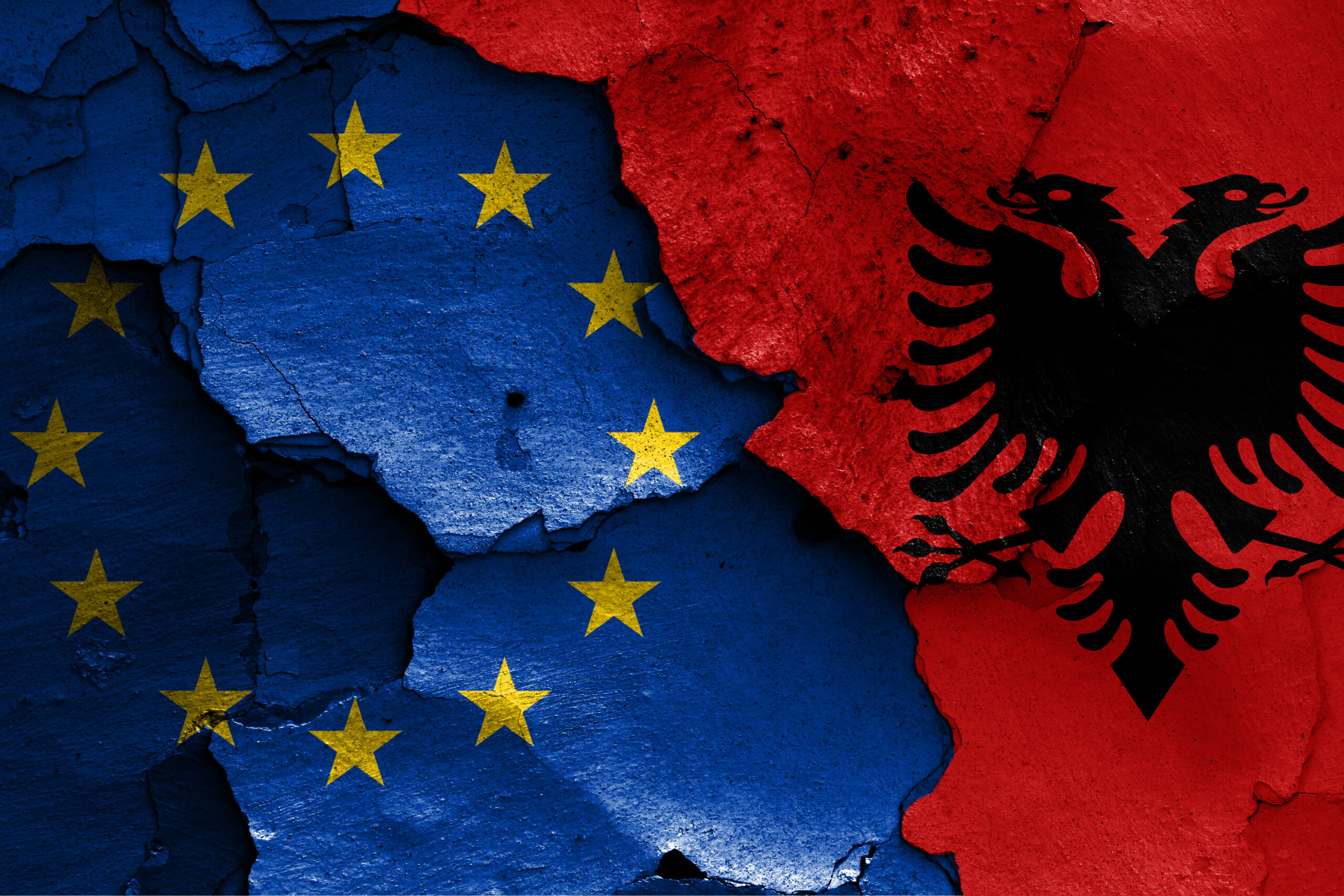
Photo: Shutterstock.com
Who was Enver Hoxha, and how did he come to power?
Enver Hoxha came from a Muslim middle-class family that provided him with a relatively stable social background and, through influential connections, access to quality education. From an early age, he showed ambition to advance socially, viewing education as a key tool for upward mobility. His studies at the prestigious French lycée in Korçë, along with later stays abroad—particularly in France and Belgium—played a crucial role in shaping his intellectual and political profile. Although he did not complete his university studies (natural sciences in France and law in Belgium), it was during this period that he encountered Marxist ideas and gradually adopted a Marxist-Leninist ideology, which he would later interpret in a rigid and dogmatic manner.
His ideological orientation was shaped not only by the theoretical foundations of communism but also by personal experiences with inequality and power structures that he perceived as unjust and exclusionary. These factors contributed to his radicalisation and his belief that societal transformation had to occur through revolutionary means, accompanied by strong centralisation of power and the elimination of opposition. Hoxha thus emerged as a committed proponent of orthodox Marxism-Leninism, emphasising ideological purity and absolute loyalty to the state.
A key moment in his political rise came during World War II, when he became the leader of the communist resistance movement. During the occupation of Albania—first by Italy and later by Germany—and in the absence of a stable political authority, he managed to effectively consolidate power and gradually marginalise competing political groups, including nationalist and monarchist movements. By leveraging the organisational structure of the communist movement and support from abroad, he secured a dominant position that enabled him to take control of the state after the war.
After seizing power, he proceeded to systematically build a totalitarian regime based on the centralisation of political authority and ideological control over society. All decision-making processes were concentrated within a narrow circle of power, while political opposition was eliminated. Hoxha also established an extensive repressive apparatus, including the state security police known as Sigurimi, through which he maintained regime stability. His ideology extended beyond politics and economics into cultural and social life. Particularly radical was his stance on religion, which he viewed as a potential threat to state unity and ideological control. This approach culminated in the complete suppression of religious life in 1967, when atheism was constitutionally enshrined, and a homogeneous, ideologically conformist society was enforced.
The way Hoxha established and maintained power led to the creation of a rigid and highly centralised system, the consequences of which extend beyond his rule and remain a significant factor in analysing Albania’s contemporary political and institutional development.
Source: Shutterstock.com
Foreign Policy Relations of Albania
The foreign policy of Enver Hoxha was shaped by three key alliances that defined Albania’s political trajectory in the following decades.
Yugoslavia
In the immediate aftermath of World War II, Yugoslavia became Albania’s first crucial partner. This relationship was grounded in a shared experience of anti-fascist resistance and ideological affinity between communist movements. Yugoslav representatives played a significant role in consolidating communist power in Albania.
Cooperation developed primarily in the economic and military spheres. Belgrade provided Tirana with extensive material and financial assistance, which was essential for post-war reconstruction. At the same time, it sought to extend its influence into the cultural and educational sectors, thereby securing long-term leverage over Albanian society. However, the relationship was inherently asymmetrical, as Josip Broz Tito viewed Albania as a potential component of a broader federal project.
Tensions gradually increased, largely due to concerns within the Albanian leadership about the loss of sovereignty. A decisive turning point came in 1948, when the conflict between Yugoslavia and Joseph Stalin escalated. Albania chose to align with the Soviet Union, leading to an immediate rupture in relations with Belgrade.
The collapse of this alliance resulted from a combination of geopolitical conflicts and incompatible ambitions. For Albania, this development was significant, as it reinforced caution toward foreign partnerships and contributed to the emergence of an isolationist orientation.
The Soviet Union
Following the break with Yugoslavia, the Soviet Union became Albania’s next key strategic partner. This alliance was based on ideological proximity and Albania’s need for security guarantees and economic support. The shift toward Moscow was accompanied by internal purges aimed at eliminating Yugoslav influence and consolidating the regime’s power.
For the Soviet Union, Albania held strategic importance due to its position in the Mediterranean, while for Albania, the partnership represented an existential safeguard. Moscow provided extensive financial, technical, and military assistance, enabling the country’s industrialisation and the implementation of a centrally planned economy.
This relationship was critical for Albania, as it extended into virtually all areas of state functioning. However, it also created a strong dependency on an external actor. Problems emerged after Stalin’s death, when the new Soviet leader Nikita Khrushchev initiated a process of de-Stalinization. This ideological shift directly conflicted with the rigid Stalinist orientation of the Albanian regime.
The split thus became inevitable. Albania refused to adapt to Moscow’s new course, leading to the severance of relations in 1961. The Soviet Union subsequently withdrew all assistance, once again leaving Albania in a state of isolation. This conflict demonstrated that the regime’s ideological rigidity made long-term stable alliances unsustainable.
China
After breaking with the Soviet Union, Albania found itself without a strategic partner, prompting it to seek a new alliance. This role was assumed by China, which at the time adhered to a similarly rigid interpretation of Marxism-Leninism and rejected Soviet de-Stalinization. Ideological proximity thus formed the basis for cooperation between two geographically distant but politically aligned regimes.
Chinese support was primarily economic. Loans and technical assistance enabled Albania to continue industrialisation and stabilise its economy after the loss of Soviet aid. At the same time, China promoted the principle of self-reliance, encouraging Albania to gradually reduce its dependence on external resources. This concept later evolved into a policy of full autarky during Albania’s period of extreme international isolation.
Despite initial stability, this relationship also gradually deteriorated. The key issue was a shift in China’s foreign policy, as it began opening up to the world and establishing relations with Western countries, including the United States. This pragmatic turn was unacceptable to the Albanian leadership, as it contradicted its ideological rigidity.
The final break came in 1978, when China terminated all assistance. Albania was thus left completely isolated, without any significant ally. This development confirmed that its foreign policy was ultimately unsustainable, as it was rooted in ideological dogmatism that prevented the formation of stable and pragmatic partnerships.
The Road to Isolation
A series of failed alliances and repeated diplomatic ruptures gradually led Albania into near-total international isolation. However, this isolation was not imposed—it was largely self-imposed. Following unsuccessful relationships with Yugoslavia, the Soviet Union, and China, it became evident that Enver Hoxha’s strong ideological rigidity acted as a barrier to all partnerships. Each of these allies was sooner or later labelled ideologically unreliable. After the final break with China, Hoxha found himself without any strategic partner, leaving his regime fully dependent on its own resources for the first time.
The regime had, however, already been preparing for this scenario. A key moment was the adoption of a new constitution in 1976, which entrenched principles of absolute political control and economic self-sufficiency. The constitution formalised the monopoly of the Albanian Party of Labour, rejected any foreign military presence, and established autarky as the foundation of the economic system. The most radical measure was the prohibition of foreign loans and cooperation with external partners, effectively cutting the country off from international capital.
The consequences of this policy quickly became evident in the economic sphere. Isolation, combined with inefficient economic management, led to declining productivity—particularly in agriculture—and to chronic shortages of basic goods. The situation was further aggravated by interventions in the private sector and full collectivisation, which eliminated individual initiative. The economic model based on self-sufficiency thus proved unsustainable in the long term, as Albania lacked the capacity to produce enough to meet domestic needs.
At the same time, internal repression intensified. Rather than fostering a sense of security, isolation deepened the regime’s distrust toward both the population and the political elite. A symbol of this paranoia was Blloku in Tirana, a closed-off district where the party elite lived under constant surveillance. This atmosphere of suspicion led to further purges, which reached even the highest political circles, including long-time Prime Minister Mehmet Shehu. His death under unclear circumstances highlighted the extent of the regime’s repressive apparatus.
In this way, isolationist policies gradually resulted in economic decline, political rigidity, and growing internal tensions. The regime, built on autarky and absolute control, endured until Hoxha’s death in 1985, leaving behind a country significantly underdeveloped and largely disconnected from broader European developments.
Photo: Shutterstock.com
Albania’s Integration Efforts towards Membership in the European Union
The process of Albania’s integration into European structures represents a long-term and gradual development closely linked to the country’s transformation following the fall of the communist regime. The first steps towards the European Union can be traced back to the early 1990s, when Albania was undergoing fundamental political and economic restructuring. In 1991, it was included in the PHARE programme, which aimed to support post-communist countries in building institutions and transitioning to a market economy. For Albania, emerging from an extremely isolated and centralised system, this assistance represented a crucial impulse for stabilising basic state functions.
A more formal framework for relations was established in 1992 with the signing of the Trade and Cooperation Agreement, which opened space for political dialogue between Albania and the European Union. Nevertheless, this was largely a declaratory step without concrete implementation mechanisms. A more significant shift occurred in the late 1990s in connection with the regional stabilisation of the Western Balkans. Following the conflicts in the former Yugoslavia, the European Union adopted a more active approach to integrating the region, particularly through the creation of the Stabilisation and Association Process (SAP) in 1999. This framework set clear conditions that countries had to meet in order to move closer to EU membership, with emphasis on democratisation, the rule of law, and economic reforms.
The key instrument of the SAP became the Stabilisation and Association Agreements, which provided a concrete legal basis for relations with the European Union. Albania signed this agreement in 2006, thereby committing itself to extensive reforms in state functioning, institutional strengthening, and the harmonisation of legislation with EU law. At the same time, it opened the path for the gradual creation of a free trade area and economic integration. This step was crucial, as it transformed previously declaratory relations into a binding reform process.
Based on progress in implementing the agreement, Albania submitted its official application for EU membership in 2009. In the same year, it also became a member of NATO, signalling its orientation towards Euro-Atlantic structures and its ability to meet security standards. In 2014, it was granted candidate country status, moving its integration process to a new phase. Despite this progress, persistent issues—particularly corruption, the functioning of the judiciary, and the effectiveness of public administration—continued to slow down the integration dynamics.
A turning point came in March 2020 with the decision to open accession negotiations, which formally began in July 2022. These negotiations are conducted through so-called clusters, which group together thematic areas of EU policy. The cluster approach allows for a more systematic assessment of a country’s preparedness while also better reflecting the interconnectedness of different sectors.
Analysis of Individual Clusters
Although Albania is among the fastest-progressing candidate countries, its advancement remains significantly hindered by the legacy of the communist period. It is evident that the historical legacy of a centralised and repressive regime manifests most strongly in weak institutions, insufficient judicial independence, and persistent corruption.
Broadly, the clusters can be divided into several key areas: fundamental values (rule of law, democracy, public administration), the internal market, competitiveness and inclusive growth, the green agenda and sustainable connectivity, and resources, agriculture, and cohesion. The first cluster, focused on the rule of law, represents the core of the entire process, as progress in this area conditions advancement in all others.
The analysis of individual clusters, therefore, makes it possible to assess the extent to which Albania is capable of overcoming its historical limitations and aligning with EU standards. The integration process should not be understood merely as a technical adoption of legislation, but rather as a profound transformation of the state and society, whose success is significantly shaped by the legacy of the communist era.
Within Cluster 1: Fundamentals, the key shortcomings are concentrated in the area of the rule of law. The main issues include the limited independence of the judiciary, political interference in decision-making processes, and the insufficiently effective prosecution of corruption and organised crime. Although institutions formally exist, their practical functioning is weakened by low credibility and limited institutional capacity.
Cluster 6: External Relations highlights a relatively high level of formal alignment with EU foreign policy; however, problems arise at the level of implementation. Weaknesses are particularly evident in the administrative preparedness of the state and its ability to respond to hybrid threats and disinformation, which is linked to the insufficient professionalisation of public administration.
In the case of Cluster 2: Internal Market, it becomes clear that although Albania has established basic regulatory frameworks, their enforcement remains inadequate. Significant shortcomings persist in combating money laundering, market surveillance, and the regulation of sensitive sectors such as healthcare. A major issue is weak oversight and the interconnection between economic actors and political structures.
Cluster 3: Competitiveness and Inclusive Growth reveals institutional deficiencies in economic governance. A key problem is the insufficient independence of the central bank and the ongoing risk of political interference in economic policy. Corruption further undermines the business environment and reduces the effectiveness of public policies, while the digitalisation of public administration has not yet been able to fully address these shortcomings.
In Cluster 4: Green Agenda and Sustainable Connectivity, problems related to the state’s limited implementation capacity are particularly evident. These are most pronounced in the field of environmental protection, where regulatory standards exist but enforcement remains weak. Corruption and clientelism also affect public procurement in infrastructure projects, hindering the efficient use of resources.
Finally, Cluster 5: Resources, Agriculture and Cohesion points to serious deficiencies in the management of public finances and EU funds. Weak administrative capacity and insufficient control mechanisms create space for corruption, particularly in the allocation of resources in agriculture and regional policy. Additional issues include low standards in food safety and inadequate oversight in the fisheries sector.
From a comparative perspective, it is evident that although Albania has made progress in aligning its legislation with the EU acquis, its main challenge remains the transformation of formal rules into effectively functioning institutions. Corruption and weak state capacity thus represent a cross-cutting problem that permeates all clusters and significantly slows down the integration process, despite its formally positive trajectory.
Impacts of the Hoxha Regime on Albania’s Current EU Integration Process
Although contemporary Albanian society is no longer directly shaped by the communist regime, its consequences remain evident, particularly in the context of the country’s integration process into the European Union. Despite ongoing reforms, Albania continues to face challenges whose origins can be traced back to the communist period. The most significant of these is systemic corruption, which permeates multiple sectors. One of its key manifestations is the low level of trust in judicial institutions—courts suffer from insufficient capacity, political pressure, and limited public confidence. In response to these challenges, the Albanian Assembly adopted reforms in 2021 aimed at improving the efficiency of the judiciary, which were internationally praised, particularly for introducing vetting mechanisms. Despite implementation difficulties, the process is widely regarded as an important step in combating judicial corruption, with 245 judges and prosecutors reportedly dismissed between 2018 and 2023, according to the Independent Qualification Commission.
In the immediate post-communist period, the legacy of the regime strongly influenced social attitudes, political culture, and institutional structures. Although Albania has gradually moved away from its past, its impact remains a significant factor in shaping the EU integration process. The regime of Enver Hoxha left the country with structural weaknesses, and its transformation has proven to be a long-term and complex process that has not yet been fully completed. Nevertheless, Albania continues to make steady progress, and its prospects for membership in the European Union appear increasingly attainable.
________________________________________________________________________________
Henrieta Vengrínová is an Intern at the Strategic Analysis Young Leaders Programme
Disclaimer: Views presented here are those of the author solely and do not necessarily reflect the views of the Strategic Analysis.
Sources:
-
Beshku, Klodiana, Western Balkan Center, From a European Community Enthusiast To EU Membership, https://newlinesinstitute.org/wp-content/uploads/Alb-2-EU.pdf
-
European Council, Consilium, Second Accession Conference with Albania, https://www.consilium.europa.eu/en/meetings/international-ministerial-meetings/2024/10/15/
-
European Council, Consilium, Third Accession Conference with Albania, https://www.consilium.europa.eu/en/meetings/international-ministerial-meetings/2024/12/17/
-
European Council, Consilium, Accession Conference with Albania: EU opens negotiations on the competitiveness and inclusive growth cluster, https://www.consilium.europa.eu/en/press/press-releases/2025/05/22/accession-conference-with-albania-eu-opens-negotiations-on-the-competitiveness-and-inclusive-growth-cluster/
-
European Council, Consilium, Accession Conference with Albania: EU opens negotiations on the internal market cluster,https://www.consilium.europa.eu/en/press/press-releases/2025/04/14/accession-conference-with-albania-eu-opens-negotiations-on-the-internal-market-cluster/
-
European Council, Consilium, EU opens accession negotiations with Albania on green and sustainable connectivity policies, https://www.consilium.europa.eu/en/press/press-releases/2025/09/16/eu-opens-accession-negotiations-with-albania-on-green-and-sustainable-connectivity-policies/
-
European Council, Consilium, EU opens last accession negotiating cluster with Albania on resources, agriculture and cohesion, https://www.consilium.europa.eu/en/press/press-releases/2025/11/17/eu-opens-last-accession-negotiating-cluster-with-albania-on-resources-agriculture-and-cohesion/
-
Idrizi, Idrit, Cultures of History Forum, Debates About the Communist Past as Personal Feuds: The Long Shadow of the Hoxha Regime in Albania, https://www.cultures-of-history.uni-jena.de/debates/debates-about-the-communist-past-as-personal-feuds
-
Pfannkuche, Andrew, Routledge Encyclopedia, Hoxha, Enver, https://doi.org/10.4324/9780367199838-RECW132-1
-
Rada Európskej únie, EUR-Lex, Rozhodnutie Rady a Komisie z 26. februára 2009 o uzatvorení Stabilizačnej a asociačnej dohody medzi Európskymi spoločenstvami a ich členskými štátmi na jednej strane a Albánskou republikou na strane druhej, http://data.europa.eu/eli/dec/2009/332/oj
-
Fevziu, Blendi, Enver Hoxha: The Iron Fist of Albania, ISBN 978-0-85772-908-8
-
Fischer, Bernd Jürgen, Albania at War, 1939-1945, ISBN 978-1-85065-531-2, https://www.scribd.com/document/797766565/Bernd-Ju-rgen-Fischer-Albania-at-War-1939-1945-Purdue-University-Press-1999
-
Hladký, Ladislav a Pavel Hradečný, Dějiny Albánie, ISBN 978-80-7106-939-3
-
O’Donnel, James S., A Coming of Age: Albania Under Enver Hoxha, ISBN 978-0-88033-415-0, https://scispace.com/papers/a-coming-of-age-albania-under-enver-hoxha-4hon1j2qbp
-
Sugar, Peter F., Eastern European Nationalism in the Twentieth Century, ISBN 978-1-879383-39-5, https://www.scribd.com/document/502593865/NikiforCrainic-p-274peter-sugar-eastern-european-nationalism-in-the-twentieth-century
-
Vickers, Miranda, The Albanians: A Modern History, ISBN 186064541, http://archive.org/details/MirandaVickersTheAlbanians
-
Hoffmann, Judith, Integrating Albania: The Role of the European Union in the Democratization Process, ISSN 1932-7978
-
Iseni, Fati a Agim Jakupib, Political Changes in Albania 1989-1992, ISSN 2307-4531
-
Kasmi, Jetnor, Confronting the past: The need to recognise Albania’s communist-era extrajudicial killings as crimes against humanity, ISSN 2590-2911, https://doi.org/10.1016/j.ssaho.2025.102070
-
Krasniqi, Afrim a Dorina Bërdufi, Albania’s Political Integrity: From Decommunization To Decriminalization (1990-2015), ISSN 2065-3891
-
Marku, Ylber, Albania, China, and the Sino-Vietnamese Conflict of 1979, ISSN 2589-4641, https://doi.org/10.1163/2589465X-04010006
-
Medici, Lorenzo a Arian Dedej, Democratic Evolution in Albania in the Aftermath of Candidate Country Status, ISSN 2410-3411, https://doi.org/10.56345/ijrdv10n1s124
-
Nezha, Luan, Herva Nurka a Xhuljana Biba, Organised Crime and Corruption in Albania, ISSN 2410-3411, https://doi.org/10.56345/ijrdv12n1s138
-
Slavković Mirić, Božica, Albania and Yugoslavia 1945: The Beginning of Cooperation, ISSN 2582-1601
-
Tarifa, Fatos, Albania’s Road from Communism: Political and Social Change, 1990–1993, ISSN 1467-7660
-
Tepshi, Aferdita a Arjan Qafa, The European Union and Albania, The Relations between them, ISSN 2039-2117
-
Vukadinović, Igor, The Shift in Yugoslav-Albanian Relations: The Establishment of Ties between Albania and the Autonomous Province of Kosovo and Metohija (1966–1969), ISSN 2406-0801
-
Yazgan, Hatice, Coming to Terms with the Past: Case of Albania in the European Union Process, ISSN 2147-1371
Contact us