
Contemporary Serbia Between Kyiv and Moscow: The Utility and Limits of Multi-vector Foreign Policy
Ján Jakub Kolár
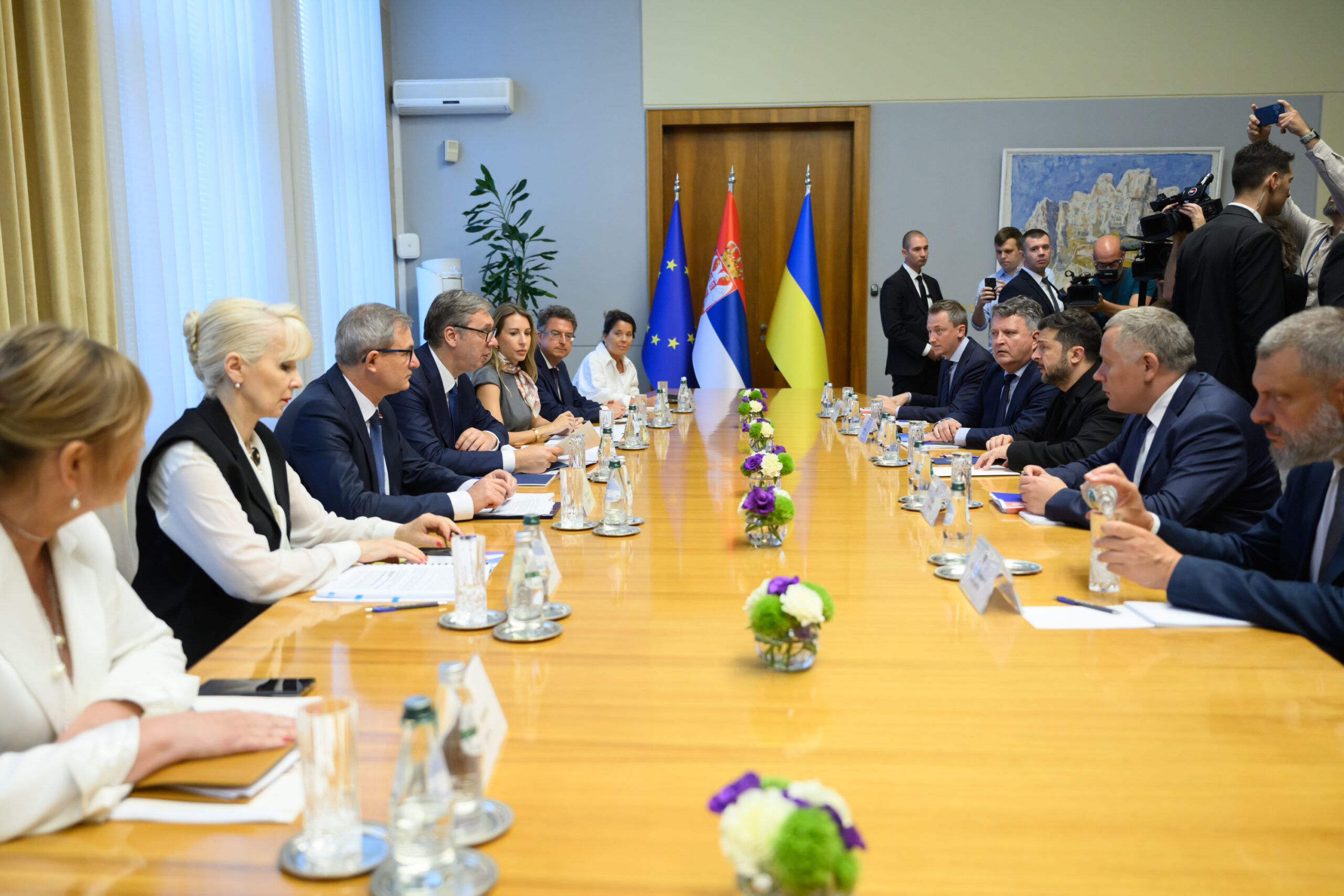
Volodymyr Zelenskyy’s 7 – 8 August 2026 visit to Belgrade, his first official one to Serbia as a Ukrainian president, marked the latest step in the intensification of Serbian – Ukrainian relations. It followed Aleksandar Vučić’s July visit to Kyiv, where Serbia pledged further humanitarian, medical, energy, and reconstruction assistance. Yet this rapprochement has not been accompanied by a comparable shift in Serbia’s policy towards Russia. Belgrade still refuses to align with Western sanctions and remains highly dependent on Russian gas. During the July summit in Kyiv, Vučić also declined to endorse language calling for continued security assistance to Ukraine and greater pressure on Moscow. The apparent contradiction raises two inter-related questions. What enables Serbia to deepen relations with Ukraine while preserving its position towards Russia, and where are the limits of this approach?
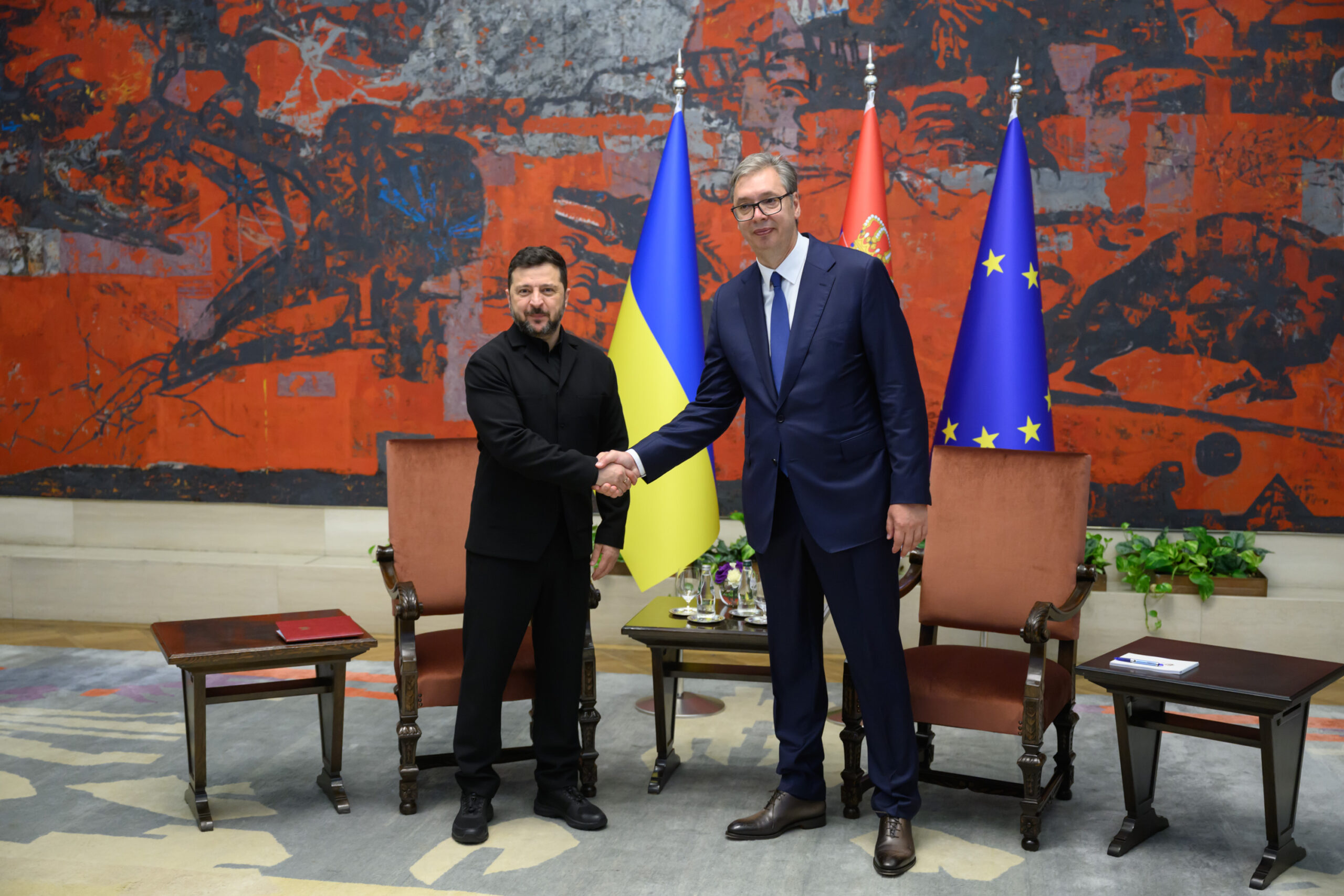
Photo: Shutterstock.com
Logic of Multi-vectorism
The enabling factor is, in the simplest of terms, Serbia’s foreign policy model. It has become commonly described as a multi-vector or a distinct form of strategic hedging (Jović-Lazić, 2025). In practice, rather than maintaining strict equidistance between competing powers, Belgrade seeks to preserve room for manoeuvre by avoiding commitments and actions that would unnecessarily constrain its other partnerships. This is reflected in Serbia’s pursuit of EU membership alongside its continued close relations with Russia and cooperation with other international actors, such as China. The palpable ambiguity is therefore not incidental to this approach but one of its defining features. It allows Serbia to work with competing partners on different issues while postponing choices that could restrict its foreign-policy options, effectively leaving the backdoor open. Implementing the policy in an international setting, Belgrade pursues cooperation where it identifies a clear national interest, while trying to avoid commitments that would unnecessarily close off relations elsewhere.
Source: Shutterstock.com
Utility of Multi-vectorism
Serbia’s contemporary relations with Ukraine, and by extension Russia, demonstrate why this strategy remains useful. As for Ukraine, the mutually shared observation of the principle of territorial sovereignty gives Belgrade a basis for supporting Kyiv without adopting the broader Western approach towards Russia. Since the beginning of the full-scale invasion, Serbia has consistently affirmed Ukraine’s internationally recognised borders, grounding that position in the UN Charter and its own commitment to protecting territorial integrity. Ukraine, meanwhile, continues not to recognise Kosovo, a position Vučić again welcomed during Zelenskyy’s August visit. Although the two cases are legally distinct, recognising Russia’s annexations would sit uneasily with Serbia’s position that changes to its own borders cannot be legitimised without Belgrade’s consent. This overlap has created a limited but politically useful area of convergence. The recent expansion of bilateral ties has focused on humanitarian assistance, trade, infrastructure, and energy, while both governments have expressed interest in completing their long-delayed free-trade agreement. Kyiv also has practical reasons to accept partial Serbian cooperation rather than demand comprehensive alignment. Serbian recognition of Ukraine’s borders carries diplomatic value because of Belgrade’s historically close relationship with Moscow, while expanding economic ties creates benefits independent of Serbia’s sanctions policy. For Serbia, this amounts to relatively low-cost hedging, enabling relations with Kyiv to deepen without forcing a corresponding change in its relationship with Russia.
Limits of Multi-vectorism
The war in Ukraine has nevertheless narrowed the space in which this ambiguity can operate and, in doing so, exposed the limits of Serbia’s multi-vector foreign policy. Recent research (Mitrović, 2025) has described the conflict as the most serious stress test yet for Belgrade’s hedging strategy. To elucidate, the difficulty emerges when Serbian policy begins to produce direct consequences for one of the actors it is trying to balance. The clearest example is Serbian-produced ammunition reportedly reaching Ukrainian forces through third-country buyers. Reuters (Landay and Vasovic, 2023) initially reported that a leaked 2023 Pentagon document indicated Serbian willingness to provide arms to Ukraine. Despite Belgrade’s immediate denial that it supplies Kyiv with weapons, in May 2025, the allegations resurfaced when Russia’s Foreign Intelligence Service (SVR) accused Serbian defence companies of supplying ammunition through intermediaries, including NATO states. Vučić disputed parts of the allegation and agreed with Moscow to investigate how Serbian-made ammunition had reached Ukraine. By 2026, the ammunition issue was being cited as an indismissible factor behind the subtle deterioration in relations between Belgrade and Moscow (Zweers, 2026). The illustrated ammunition issue is hence qualitatively different from Serbia’s diplomatic support for Ukrainian sovereignty, where statements on territorial integrity can be reconciled with Belgrade’s established position on international law and Kosovo. To a great extent, even commercial arms exports can still be presented as transactions devoid of ill-intent and conducted independently of the war. However, once Serbian-produced ammunition eventually reaches Ukrainian forces, the distinction between intention and effect becomes harder to sustain. From Moscow’s perspective, the contractual route of a shipment does not alter its eventual military use and presents, as SVR bluntly branded it, a “stab in the back” (Al Jazeera, 2025). This development therefore reveals a clear boundary to Serbia’s hedging strategy that even ambiguity cannot fully obscure or transcend. Equivocalness is most effective when competing partners can tolerate different interpretations of Serbian behaviour, i.e., Belgrade can simultaneously point to its support for Ukraine’s territorial integrity and its refusal to sanction Russia because neither position necessarily eliminates the other relationship. It nevertheless becomes considerably less useful when cooperation with one side produces a tangible cost for the other.
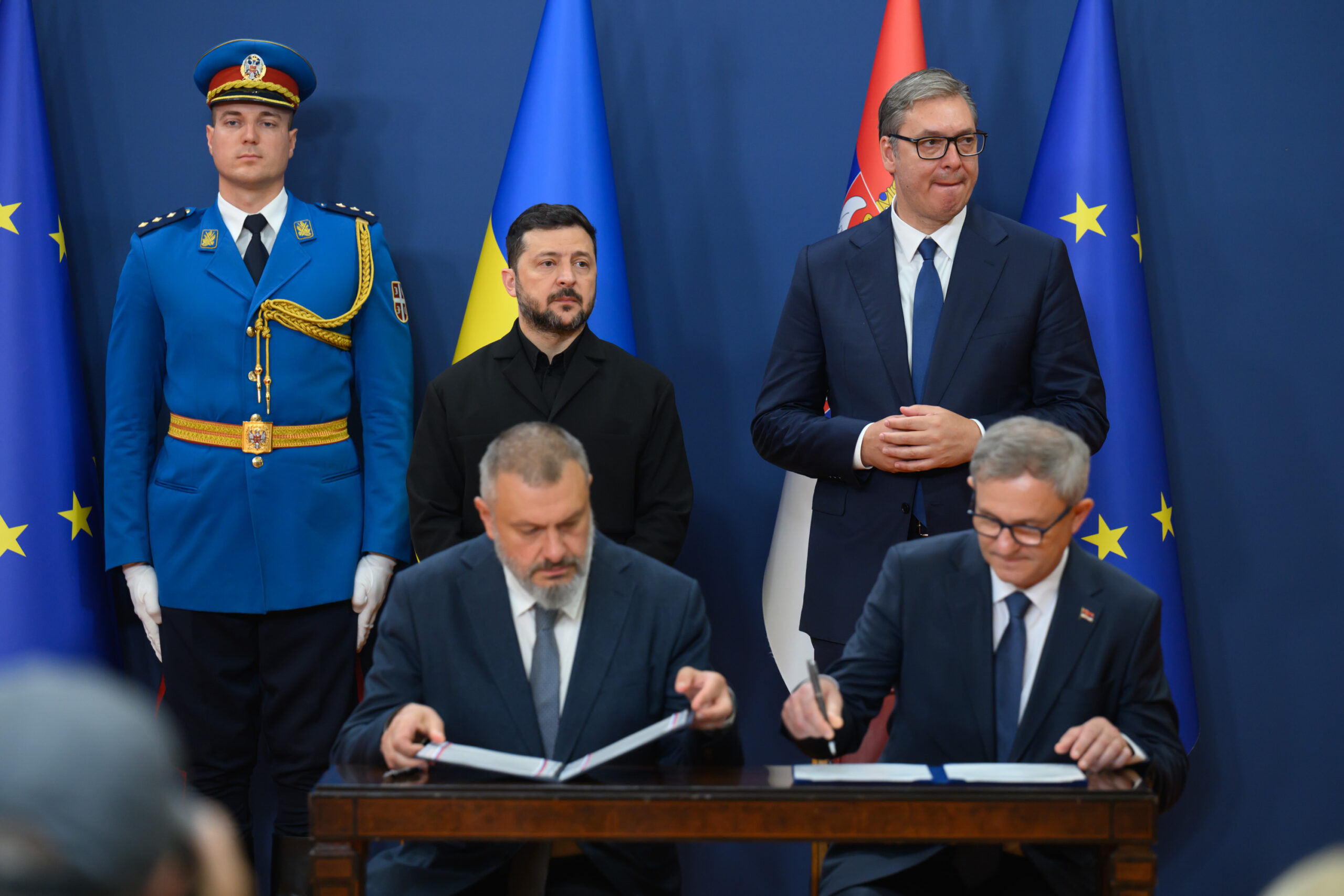
Photo: Shutterstock.com
Final thought
In essence, Serbia’s relationship with Ukraine and Russia captures both the utility and the constraints of its multi-vector foreign policy model. Territorial integrity, humanitarian assistance, and economic cooperation enable Belgrade to deepen ties with Kyiv without fundamentally altering its relations with Moscow. Serbian-origin ammunition reaching Ukrainian forces is different because it turns an ambiguous policy into a tangible and most likely detrimental outcome for Russia with its armed forces. Therefore, the challenge for the continued operability of Serbia’s foreign policy model lies not in whether Serbia can continue presenting different positions to different partners, but whether it can prevent those partnerships from colliding in practice. The relationship with Ukraine demonstrates that Serbia still retains considerable room for manoeuvre. On the other hand, the dispute with Moscow over Serbian-origin ammunition shows that this room is no longer unlimited.
________________________________________________________________________________
Ján Jakub Kolár is an Intern at the Strategic Analysis Young Leaders Programme
Disclaimer: Views presented here are those of the author solely and do not necessarily reflect the views of the Strategic Analysis.
Sources:
- Al Jazeera (2025) ‘Serbia probes arms to Ukraine after Russia alleges ‘stab in the back’. Al Jazeera. Online: https://www.aljazeera.com/news/2025/5/30/serbia-probes-arms-to-ukraine-after-russia-alleges-stab-in-the-back
- Filippov, A. (2026) ‘Why Zelenskyy went to Russia-friendly Serbia and what Ukraine and Serbia got out of it’. European Pravda. Online: https://www.eurointegration.com.ua/eng/news/2026/08/10/7243263/
- Harmash, O. Sekularac, I. (2026) ‘Leaders of Serbia and Ukraine pledge closer economic ties’. Reuters. Online: https://www.reuters.com/business/leaders-serbia-ukraine-pledge-closer-economic-ties-2026-08-08/
- Jović-Lazić, A. (2025) ‘On the edge: Serbia between the west, Russia, and its own course’. Medjunarodni problem, 77 (3). Pp. 409 – 438. Online: https://doiserbia.nb.rs/Article.aspx?ID=0025-85552503409J
- Landay, J. and Vasovic, A. (2023) ‘Leaked U.S. intel document claims Serbia agreed to arm Ukraine’. Reuters. Online: https://www.reuters.com/world/leaked-us-intel-document-claims-serbia-agreed-arm-ukraine-2023-04-12/
- Mitrović, S. (2025) ‘Spoljna politika Srbije u kontekstu rata u Ukrajini (2022–2025): uravnotežavanje Rusije kao izazov multivektorske strategije’. Međunarodna politika, 77 (1196). P. 47–77. Online: https://doi.org/10.18485/iipe_mp.2026.77.1196.3
- Tymots, I. and Kuzmenko, Y. (2026) ‘Political scientist Shekhovtsov identified the “most important link” between Serbia and Ukraine’. net. Online: https://news.liga.net/en/politics/news/political-scientist-shekhovtsov-identified-the-most-important-link-between-serbia-and-ukraine
- Zweers, W. (2026) ‘Serbia on a Sharpening Geopolitical Edge Between Russia and the European Union’. Clingendael. Online: https://www.clingendael.org/publication/serbia-sharpening-geopolitical-edge-between-russia-and-european-union
Contact us